Airbnb in Milan: why high income alone does not explain tourist concentration
An analysis of 124 neighborhoods and 4,006 streets reveals that only 8% of Milan combines wealth and high short-term rental density -- and that the key is not income, but urban context
The concentration of short-term rentals in Milan cannot be explained by neighborhood income alone. Wealthier neighborhoods do tend to have more listings on short-term rental platforms: the correlation is statistically solid at +0.37 across 124 neighborhoods, a moderate but unambiguous link. Yet the most revealing finding is not the confirmation -- it is the exception. Nearly a third of Milan's streets sit in affluent areas with very few short-term rentals. Wealth alone does not attract tourism.
320 streets where income and tourism converge
Out of 4,006 streets analyzed, 320 -- just 8% -- combine above-average income with extreme short-term rental density. The profile is clear-cut: a median income of 51,612 euros per year, well above the city median of 33,684 euros, and 17 listings per street -- seventeen times Milan's median, where half the streets have at most one listing.
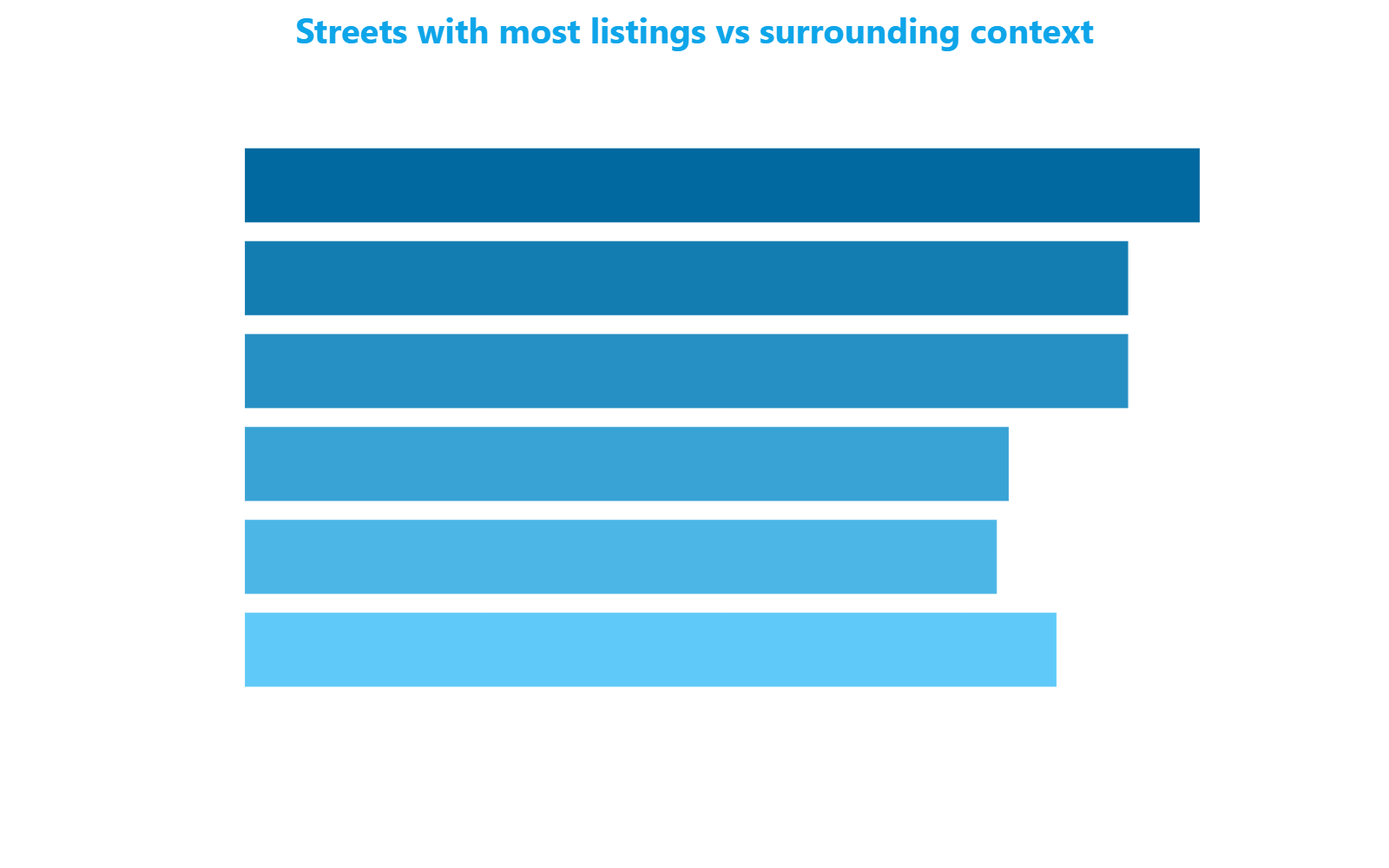
These are streets any real estate professional would recognize: Corso Garibaldi, in the Brera district, with a residual of +68 listings above surrounding streets. Via Savona, in the Tortona-Navigli district, at +74. Via Torino, the historic center's main commercial axis. Corso di Porta Romana, Ripa di Porta Ticinese -- the Navigli epicenter -- and, less predictably, Corso Lodi in the southern Porta Romana area, which records the highest residual of all: +80 listings above its neighbors, signaling an expanding tourist hotspot.
On the other side, 91% of Milan -- 3,638 streets -- shows an average profile on both fronts: income around the city median and one or zero short-term rental listings.
The asymmetry that matters: wealthy without tourism, tourism without wealth
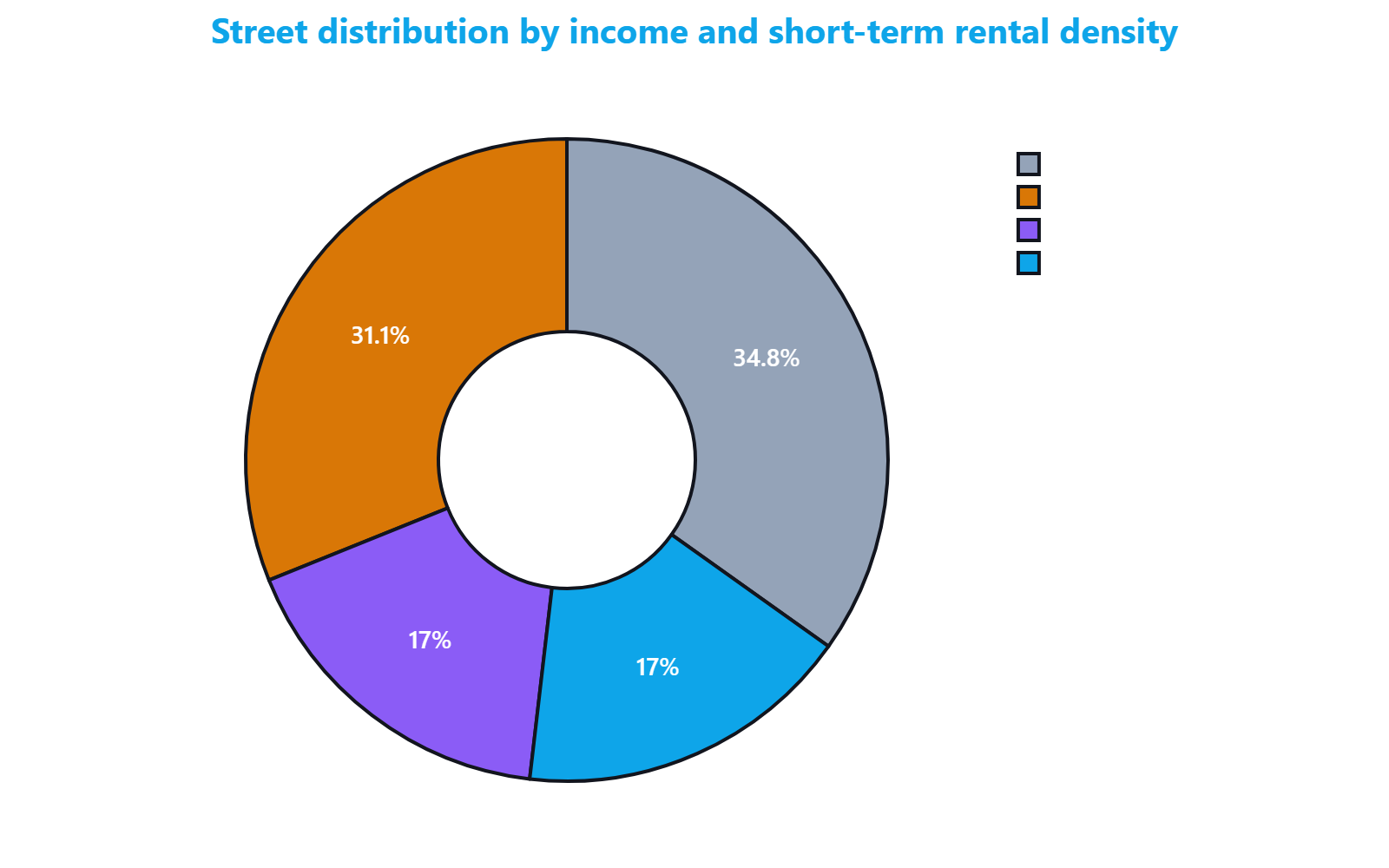
The quadrant distribution tells a more nuanced story than simple correlation. 31.1% of streets sit in neighborhoods with above-average income but below-average short-term rental density. Nearly a third of Milan is affluent yet not touristic: residential neighborhoods with no visitor attractions, where high income does not generate short-term accommodation demand.
Symmetrically, 17% of streets have more listings than the local average despite being in neighborhoods with below-average income. Tourism concentrates in these cases regardless of neighborhood wealth.
The asymmetry is almost twofold: "wealthy without tourism" streets account for 31% versus 17% for "touristic but not wealthy." High income is not a sufficient condition to attract short-term rentals -- and its absence is not a necessary condition to repel them.
Which wealthy Milan neighborhoods have no short-term rentals?
Nearly a third of Milan's streets sit in high-income areas with below-average short-term rental density. These are residential neighborhoods lacking specific tourist attractions, where wealth does not generate short-term accommodation demand. The data confirms that neighborhood income alone explains just 14% of the variance in short-term rental distribution.
Not income: restaurants, venues, and Commercial Diversity
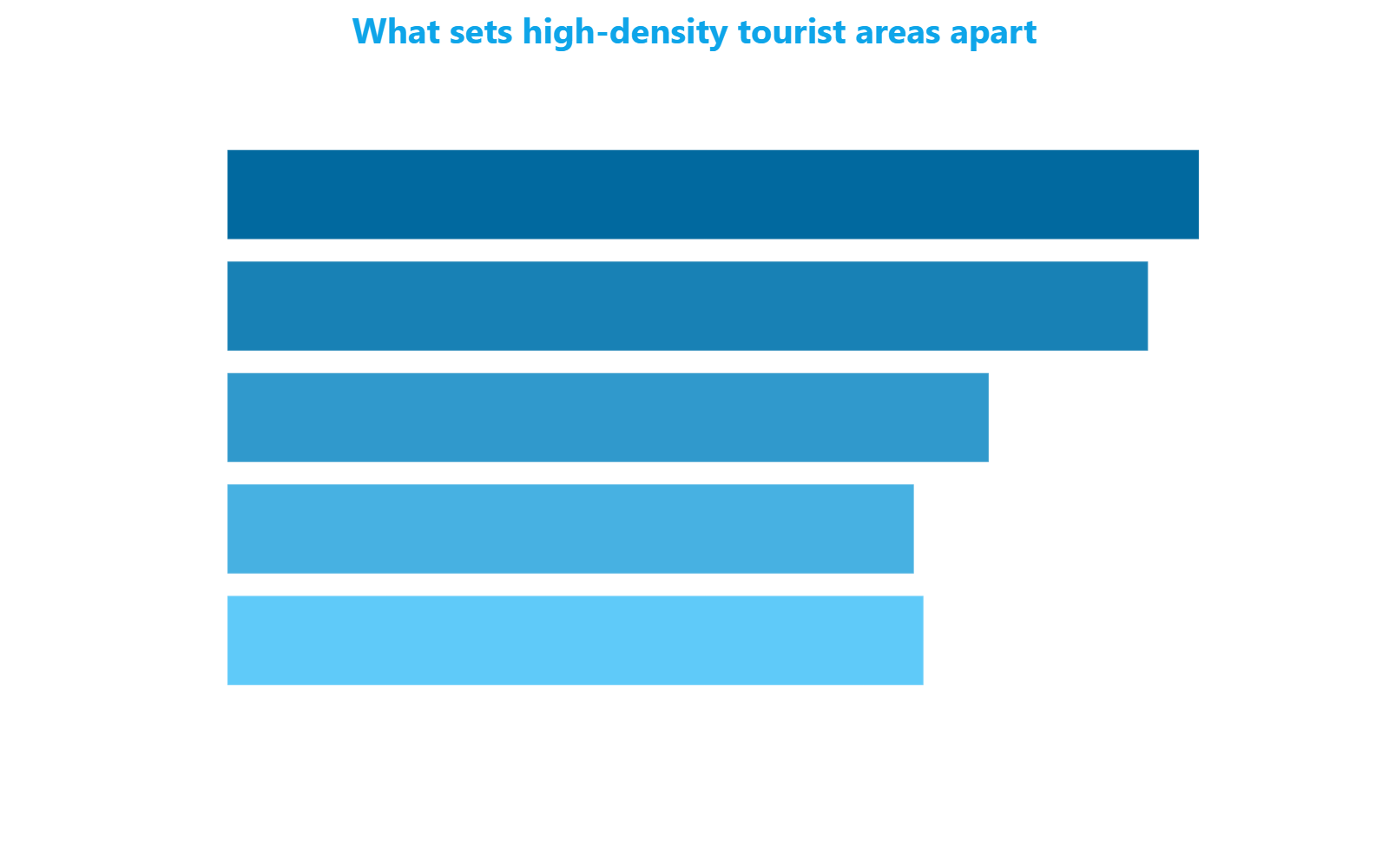
The finding that redefines the analysis emerges from cross-validation against 51 independent external signals. The 320 streets in the tourist-affluent profile do not stand out for income and listings alone: they are also the areas with the highest restaurant density, the broadest Commercial Diversity, and the most intense Nightlife in Milan. Safety scores are higher, real estate prices are steeper.
It is the complete urban context -- dining, shop variety, entertainment venues -- that characterizes high short-term rental concentration areas, not income per se. The Safety analysis draws on 27 crime categories monitored street by street, all available in detail on the platform with type, frequency, and trend data.
What really drives short-term rental concentration in Milan?
Not neighborhood income, which explains only 14% of the variance. The determining factors are urban context: restaurant density, Commercial Diversity, Nightlife, Safety, and high Real Estate Value. The 320 streets with the highest tourist concentration stand out on all these indicators, according to cross-validation conducted on 51 independent signals.
One further element: the boundary between "tourist zone" and "ordinary zone" is not fixed. Just over half of the 320 streets in the tourist-affluent profile maintain this classification consistently over time. The rest oscillate, moving in and out of the cluster -- the perimeter of short-term rental tourism in Milan expands and contracts, and borderline streets shift profiles with some regularity.
The operational takeaway
The correlation between income and short-term rentals exists, but it explains only 14% of the variance across neighborhoods. The remaining 86% is linked to other factors: location, dining options, Retail Offering, tourist Attractiveness. When conducting due diligence on high short-term rental density areas, neighborhood income is a useful but insufficient indicator: it is the overall urban profile -- restaurants, Commercial Diversity, Nightlife -- that distinguishes the areas where tourism truly concentrates. A finding that suggests caution when projecting short-term rental yields based on income alone, to be investigated case by case.
Methodology: the analysis cross-references IRPEF tax declarations at neighborhood level (124 neighborhoods) with short-term rental listing counts for each of Milan's 4,006 streets. Correlation is calculated at the neighborhood level (the granularity of income data) with verified statistical significance (p<0.001). Clustering identifies street profiles with homogeneous combinations of income and tourist density, validated for stability across neighborhood configurations (ARI=0.91). Cross-validation against 51 independent signals -- from geospatial business surveys, crime reporting analysis, a proprietary multi-source model for real estate pricing, and automated street-level image analysis -- confirms that the clusters capture real differences in the urban fabric.
Frequently Asked Questions
How many Milan streets combine high income and high short-term rental density?
Only 320 streets out of 4,006, representing 8% of the total. These streets show a median income of 51,612 euros per year and an average of 17 short-term rental listings each, seventeen times the city median. They are concentrated in areas such as Brera, Tortona-Navigli, the historic center, and the Porta Romana district.
Is neighborhood income a good predictor of short-term rental density?
No. Income explains only 14% of the variance in short-term rental distribution across Milan's 124 neighborhoods. The remaining 86% depends on factors such as restaurant density, Commercial Diversity, Nightlife, and the area's overall tourist Attractiveness.
Which streets have the most short-term rentals relative to their surroundings?
The streets with the highest residuals are Corso Lodi (+80 listings above neighbors), Via Savona in the Tortona-Navigli district (+74), and Corso Garibaldi in the Brera area (+68). Corso Lodi is a less obvious finding, signaling an expanding tourist hotspot in the southern Porta Romana area.
Are there wealthy Milan neighborhoods without short-term rental tourism?
Yes. 31.1% of Milan's streets sit in neighborhoods with above-average income but below-average short-term rental density. These are residential areas lacking specific tourist attractions, confirming that wealth is not a sufficient condition to attract short-term accommodation demand.
Is Milan's short-term rental map stable over time?
Not entirely. Just over half of the 320 streets in the tourist-affluent profile maintain this classification consistently. The rest oscillate in and out of the cluster, indicating that the perimeter of short-term rental tourism expands and contracts with some regularity.