Bovisa and Città Studi: two neighborhoods moving in opposite directions
A six-indicator comparison of two Milan university districts on diverging trajectories
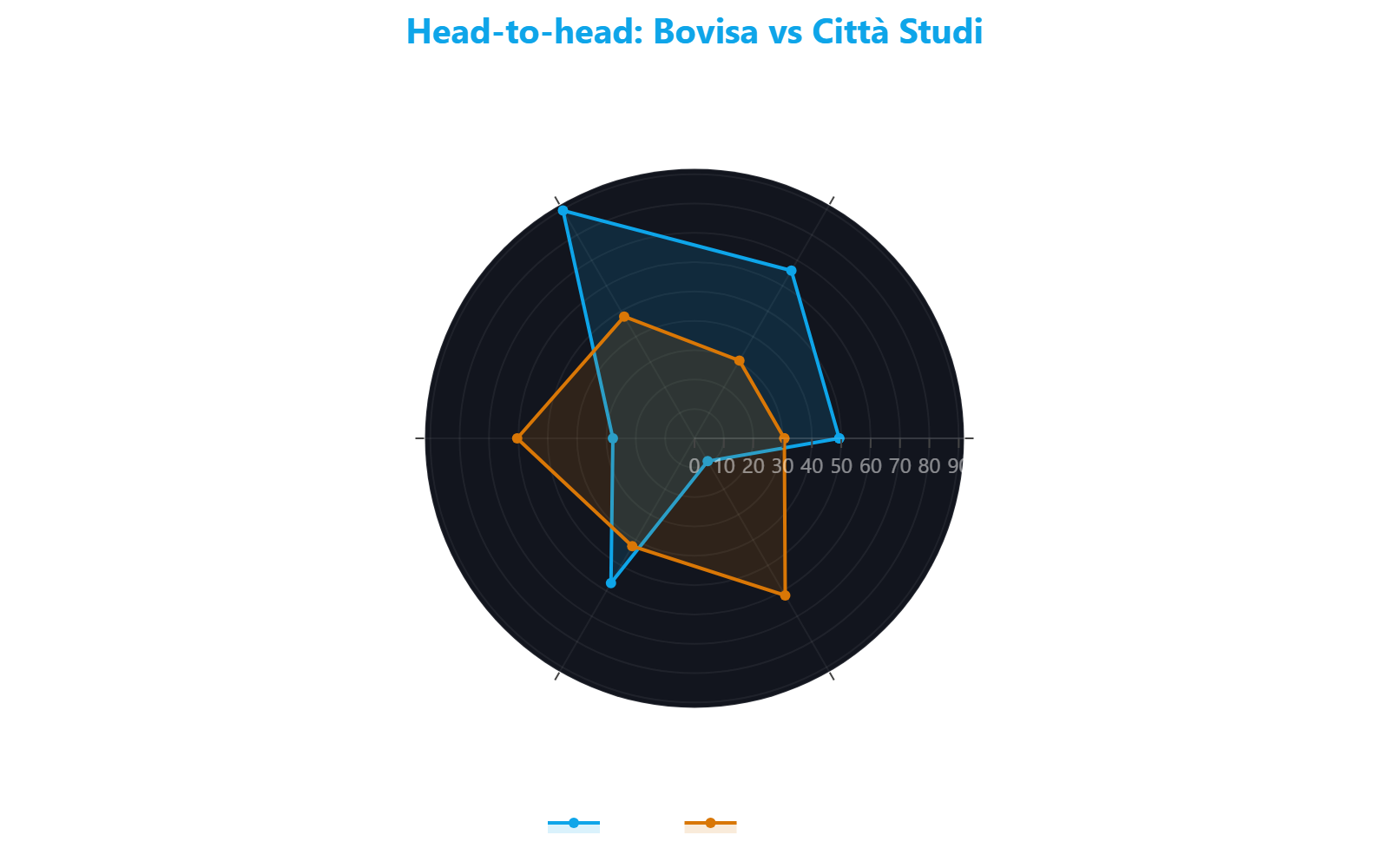
Two neighborhoods built around the Politecnico di Milano, separated by a few kilometers and a growing gap in the numbers. Bovisa and Citta Studi, two university districts in Milan, are now moving in opposite directions across nearly every urban indicator. Five years ago, Bovisa ranked 128th out of 144 neighborhoods on the CityAdvisor Index. Today it has climbed to 74th. Citta Studi traveled the reverse path: from 53rd down to 101st. The overall index -- a weighted average of ten macro-indicators spanning real estate value, safety, urban development and retail offering -- now places them less than one point apart (42.29 vs 41.27), but their trajectories tell opposite stories.
The construction boom
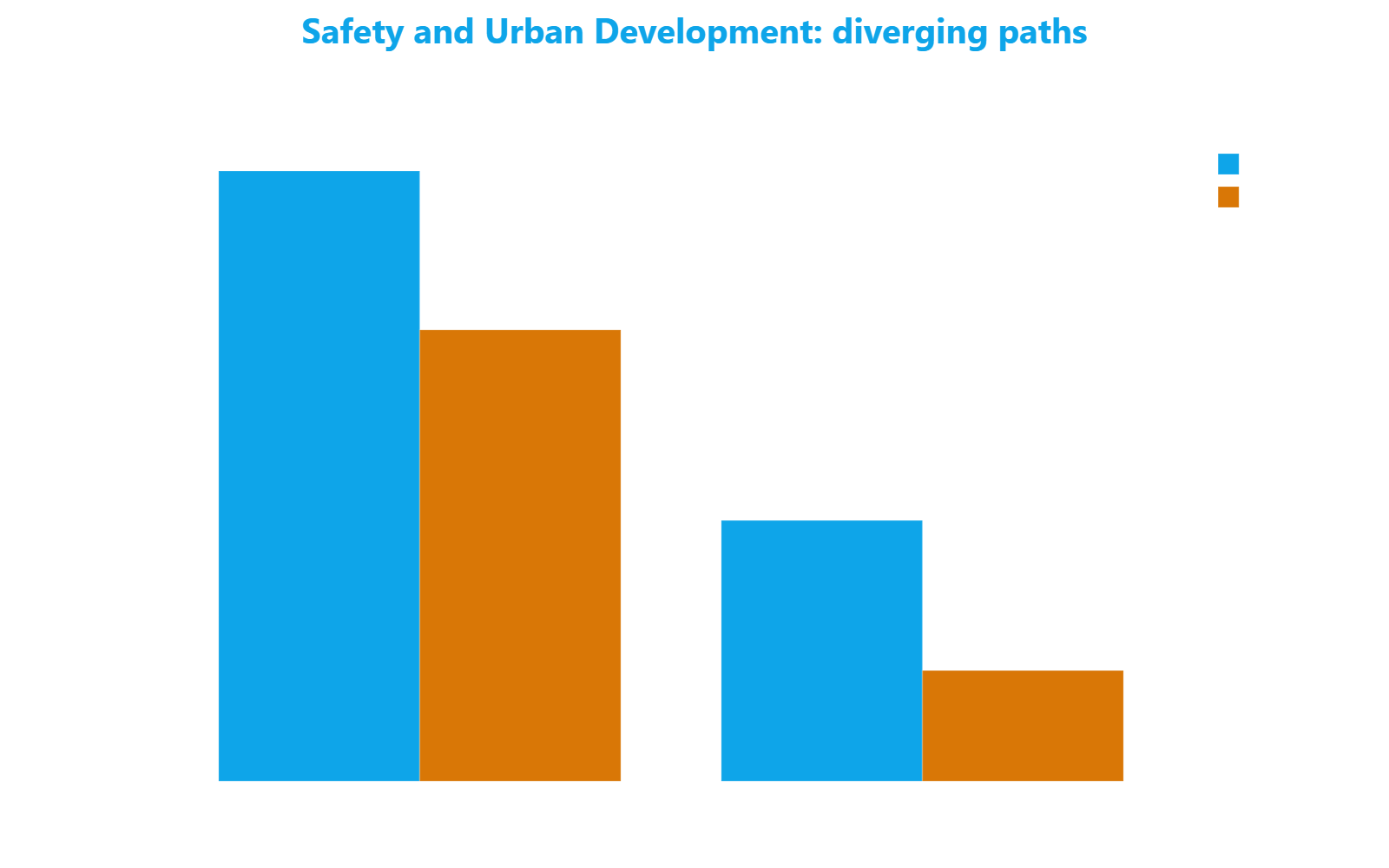
The metric that most sharply separates the two neighborhoods is Urban Development. Bovisa scores 31.77 points and ranks 16th out of 144 -- in Milan's upper tier, nearly double the city median of 13.99. Citta Studi sits at 13.47, in line with the median but declining: five years ago it scored 16.32 and ranked 47th, today it has dropped to 76th.
The raw numbers explain why. Bovisa has 7.09 active construction sites per density unit -- nearly four times the city average of 1.94. Five years ago it had 2.15: the growth has been steep. The surrounding area hosts several large-scale interventions, as tracked by sources specialized in urban development: the MoLeCoLa - Nodo Bovisa project, an urban regeneration developed by Hines with Park Associati, 17% complete and scheduled for 2030. Nearby, Innovation Hub Gasometro 2 and Sports Factory Gasometro 1 are in advanced stages, with estimated completion between 2026 and 2027. Campus Nord Goccia, a new university campus, is halfway through. Three recently completed student housing projects and over twenty minor interventions round out the picture. In total, 33 projects within the neighborhood's radius.
Citta Studi tells a different story: 22 projects, but nearly all already completed. The two M4 metro stations -- Susa and Argonne -- have been operational since 2022. The Politecnico's Bonardi campus was renovated in 2021, designed by Renzo Piano Building Workshop. Active construction sites count just 1.16 per density unit -- below the city average. The only residential project still underway, Residenza Colombo, is 92% complete. While Bovisa is in the thick of an intense construction season, Citta Studi has already reaped the benefits of its transformation with no new projects on the horizon.
How many active construction sites does Bovisa have compared to Milan's average?
Bovisa counts 7.09 active construction sites per density unit, nearly four times the city average of 1.94. Within the neighborhood's radius, 33 projects have been recorded, including urban regenerations, university campuses, student housing and residential developments, with completions expected between 2026 and 2030. Five years ago the density was 2.15: the growth has been steep.
Safety: the gap widens
Bovisa scores 74.31 points on the Safety index -- an indicator calculated across 27 crime categories monitored street by street, analyzing type, frequency and trend. It ranks 50th, above the median of 68.41. A stable value: five years ago it was 75.15.
Citta Studi stands at 54.96, ranking 101st out of 144. The decline is sharp: in 2021 it scored 68.75 -- close to Bovisa's current level -- and ranked 85th. In five years it has lost nearly 14 points. The gap between the two neighborhoods has widened from less than 7 to nearly 20 points.
How has Safety changed in Citta Studi over the past five years?
Citta Studi's Safety index dropped from 68.75 points in 2021 to 54.96 in 2026, a loss of nearly 14 points. Its ranking fell from 85th to 101st out of 144 neighborhoods. Over the same period Bovisa remained stable, widening the gap from less than 7 to nearly 20 points.
Price tells a different story
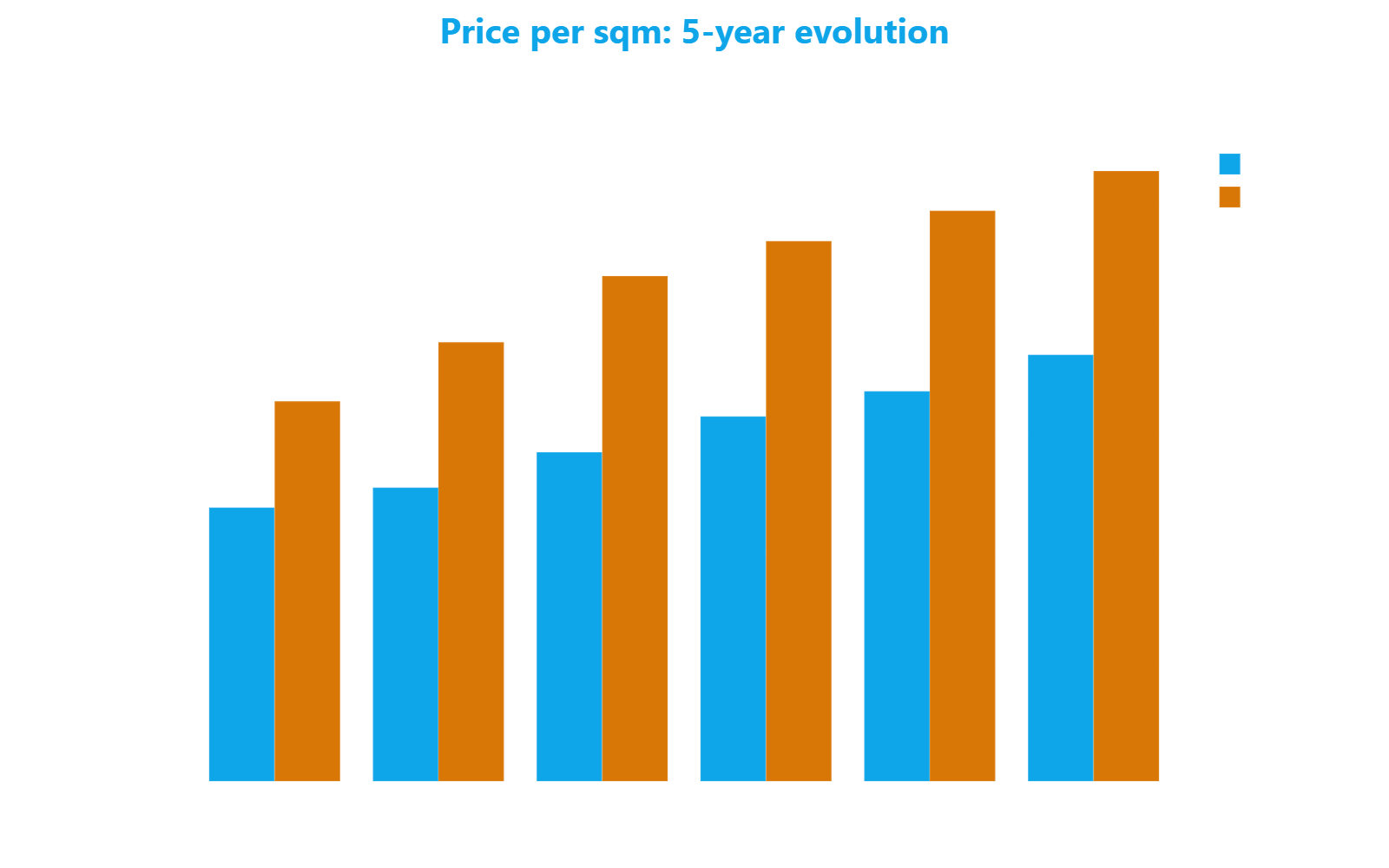
If construction favors Bovisa and safety gives it an edge, price per sqm flips the hierarchy. Citta Studi has a baseline of 5,299 euros per sqm, according to a proprietary multi-source model combining institutional valuations, recent transactions and listing prices -- a figure that can swing 30% for any given property depending on floor, condition and amenities. Bovisa is at 3,702 euros, roughly 30% lower. Both have risen sharply over five years: Bovisa from 2,377 to 3,702 euros (+55%), Citta Studi from 3,300 to 5,299 euros (+60%). Their relative ranking, however, has not changed: Bovisa stays around 105th, Citta Studi at 58th. In a city where prices rise across the board, the balance of power on pricing remains unchanged.
How much does it cost per sqm to buy a home in Bovisa and Citta Studi?
As of March 2026, the average price per sqm is 3,702 euros in Bovisa and 5,299 euros in Citta Studi, a gap of roughly 30%. Both neighborhoods have seen increases above 55% over five years, but their relative position in the citywide ranking of 144 neighborhoods has not changed: Bovisa stays around 105th, Citta Studi at 58th.
Attractiveness: Bovisa's Achilles heel
Attractiveness -- a composite index integrating Aesthetics, Urban Decorum, dining, culture and green space, measured through geospatial surveys of commercial activities and automated street-level image analysis -- is Bovisa's structural weak point. At 30.46 points it ranks 132nd out of 144, near the bottom of the table. Citta Studi scores 38.14, just below the median of 35.42 but at 56th place. The difference shows in the details: Citta Studi's Aesthetics score is 35.57 versus 24.96 for Bovisa, where the city average is 33.33.
The data reflects a neighborhood where the transformation is underway but not yet visible in the daily streetscape. Construction will reshape the urban profile, but today Bovisa's streets tell a different story from the one promised by the renderings.
Families and the overall index
On the Family Friendly index -- combining School Access, Social Infrastructure, Safety and green space -- Bovisa holds a slight lead: 57.22 points (63rd) versus 54.34 for Citta Studi (84th), both above the city median of 55.89. The difference is modest, and Bovisa's higher Safety score contributes to the advantage.
The platform contains a detailed profile for every urban development project within each street's radius: classification, scale, stakeholders, progress status and timeline.
Two models, no winner
Bovisa and Citta Studi represent two different phases of the same cycle. Bovisa is in the thick of transformation: construction everywhere, Urban Development at the top of the city rankings, prices still accessible but rising fast at 55% over five years, solid Safety. The limitation is an urban fabric that has not yet absorbed the change. Citta Studi has completed its season of interventions -- M4, campus, residences -- and shows the results in prices and Attractiveness, but is losing ground on Safety with no new construction to sustain its trajectory. A bet on the future versus an established asset: the choice depends on the investment horizon, to be evaluated case by case.
Methodology: direct comparison between 2 neighborhoods across 6 metrics. Period: March 2026. Rankings indicate position within the citywide distribution of 144 neighborhoods. Neighborhood values are the average of their component streets. Data from public and proprietary sources, covering 4,006 streets, 105 metrics and monthly history from January 2020.
Frequently Asked Questions
Is Bovisa a good neighborhood to invest in during 2026?
Bovisa shows strong transformation indicators: 33 urban development projects within the neighborhood's radius, active construction density four times the city average, and an Urban Development index ranking 16th out of 144. The price per sqm of 3,702 euros has grown 55% in five years but remains roughly 30% below Citta Studi. Safety is above the median. The current limitation is Attractiveness, ranking 132nd.
Why is Citta Studi dropping in Milan's rankings?
Citta Studi has fallen from 53rd to 101st in the CityAdvisor Index over five years. The decline is driven by two factors: the Safety index lost nearly 14 points (from 68.75 to 54.96) and Urban Development dropped from 47th to 76th, with nearly all construction projects now completed and no significant new interventions planned.
What is the price difference between Bovisa and Citta Studi?
As of March 2026, Citta Studi has an average price per sqm of 5,299 euros versus 3,702 euros for Bovisa, a gap of roughly 30%. Both neighborhoods have seen significant growth since 2021: +60% for Citta Studi and +55% for Bovisa. The value for any individual property can swing 30% depending on floor, condition and amenities.
Which neighborhood is safer, Bovisa or Citta Studi?
Bovisa is significantly safer with 74.31 points versus 54.96 for Citta Studi, calculated across 27 crime categories monitored street by street. The gap has widened over time: in 2021 the difference was less than 7 points, today it exceeds 19 points. Bovisa ranks 50th out of 144, Citta Studi 101st.
Bovisa or Citta Studi for a family with children?
The two neighborhoods are close on the Family Friendly index: Bovisa scores 57.22 points (63rd) and Citta Studi 54.34 (84th), both above the city median of 55.89. Bovisa's slight advantage is linked to its higher Safety score. Citta Studi, however, offers greater Attractiveness in terms of Aesthetics, dining and cultural services.