Before building CityHero, we asked home buyers what they would really need
CityAdvisor is building CityHero, an assistant for home buyers. Before deciding what to put in it, it had real, identity-verified people interviewed by Humatic's AI interviewer: here is how it went and what emerged.
The problem: building for home buyers without guessing
Anyone buying a home in Milan today relies on three tools: listing sites, estate agents and word of mouth. None of them answers the questions that really matter: is this the right area for me? Is the price fair? How much should I offer?
CityHero was created to answer those questions. It is the home-buying assistant CityAdvisor is building: it helps choose areas and homes, tells you whether a listing's price is fair and how much to offer, assists during viewings, even through the phone camera, finds a trusted surveyor or notary, tells you how much you can spend and helps with the mortgage, and estimates what the home would earn if rented out. And it answers on WhatsApp.
Seven features are a lot, and they are not all worth the same. Before deciding which ones to put at the centre, CityAdvisor chose to ask the people who actually buy homes: it is how companies and startups validate a product before building it.
The study: thirteen questions, and the ones nobody had written
The study, "Buying a home: what would you really need?", was run on Humatic, with AI-led interviews with real, verified people. Individual written interviews, in Italian, on thirteen questions agreed with CityAdvisor and grouped into four areas: the situation of the person looking for a home, what worries them, what the service is worth, how much to pay for it.
The difference from a questionnaire lies in what happens after each answer. In a survey the click closes the question; here it opens it. To someone who had given the neighbourhood map the top score, the interviewer asked:
"You gave it 7, the maximum: between what you would look at in the area and in the home, what matters most to you?"
With someone who said they would not pay for the service, it did not stop at the no:
"Think about what you usually spend on other services or subscriptions you use: what makes the difference between a cost that feels fair and one you would not pay?"
None of these questions was in the script. They came from what the person had just written, and that is where the most useful answers emerged.
Who answers: real people, and proof that shows it
A growing share of online answers is now written by bots or language models. That is why people who take part in Humatic studies are verified before they answer: identity document read, face matched against the document, one account per person. During the interview the system observes the process by which answers are written, not just the final text; at the end a judge assesses every interview.
From the record of one of the interviews:
"There are 1,492 keystrokes with an average cadence of 193 milliseconds between one key and the next, typical of a person typing. There is no pasted or dragged text and no paste attempt, with the page blocking paste."
Every interview in the study passed the genuineness check.
What emerged
The worries: the mortgage and the area. Faced with a list of eight concerns, interviewees put the mortgage and the choice of area at the top. On the mortgage, even people with a stable contract do not take it for granted: "banks often have limits for those who may not have a down payment to give". On the area, the idea is precise: "The area is very important, it must be central, quiet, well served".
The features: tools that help you evaluate win. Three features were shown with an image, and all three received the top score, 7 out of 7: the map that scores neighbourhoods and homes according to your priorities, the card that estimates the offer to make and your strength in the negotiation, and the image of the home as it is today and as it would look renovated.
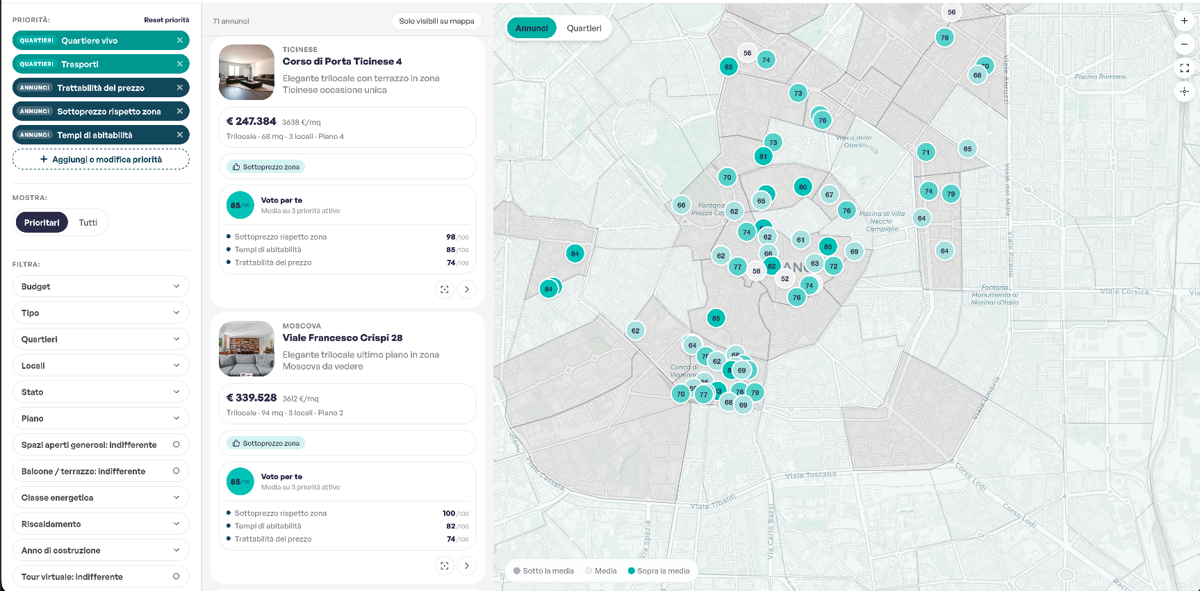 The CityHero map: a score for neighbourhoods and homes based on the buyer's priorities.
The reasons are practical: the negotiation card "already gives me a kind of complete picture in advance of what I could or could not do"; the renovated home "already gives me an idea of how I could actually use that space".
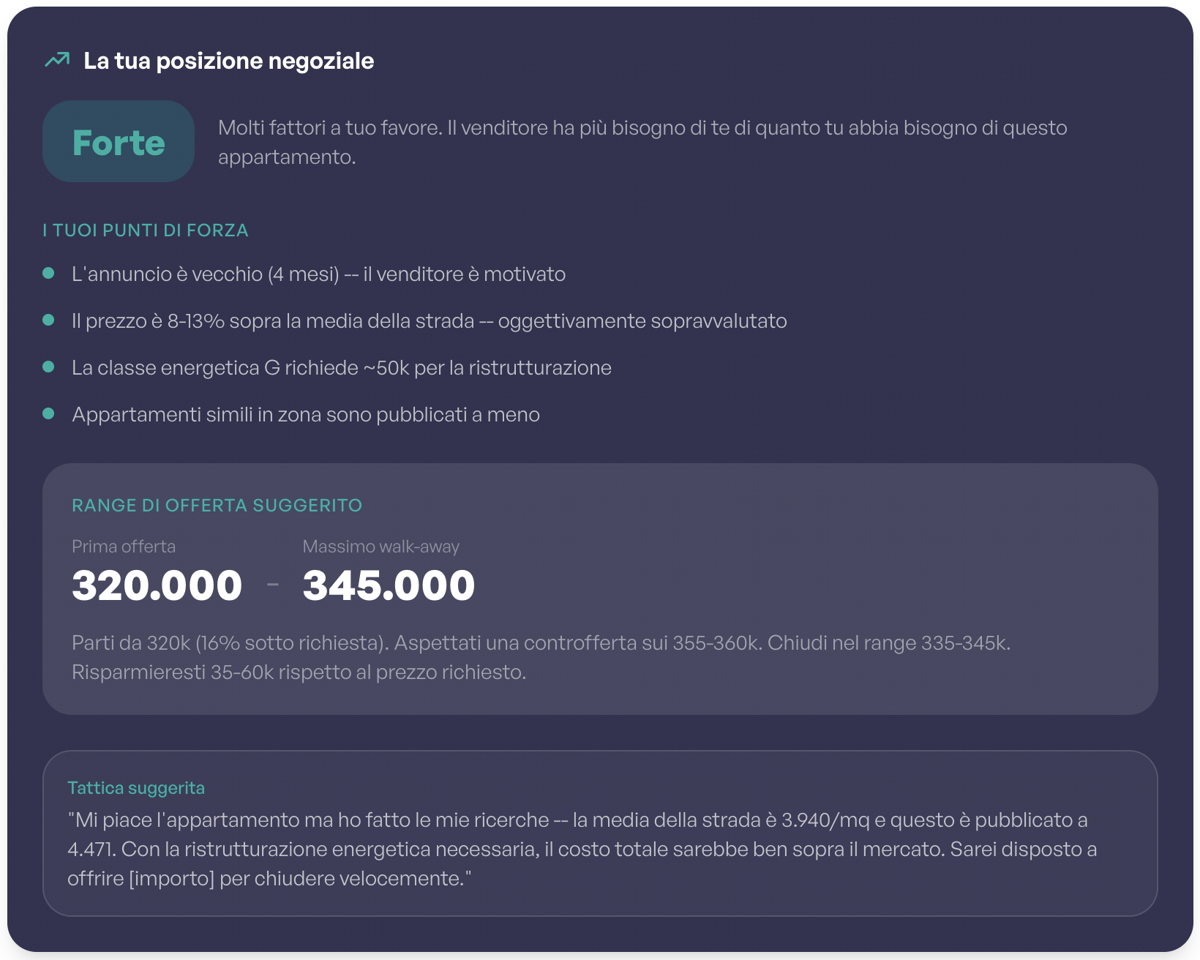 The negotiation card: the buyer's strength and the suggested offer range.
Choosing areas and homes and being able to message the assistant on WhatsApp also ended up at the top of the feature list: "with a thousand commitments, having direct contact via WhatsApp or another app is definitely a big help".
The barriers: data and value. There were two reasons not to use the service. The first is the security of personal data such as salary and savings: the fear "that my private data could be breached". The second is subtler: someone who has already bought a home easily feels their own judgement is enough, because what counts is "how much I might like the home when I walk in".
The price: under 30 euros a month. Nobody chose "I would only use it for free", nobody chose "30 € or more". The ranges indicated fall between 10 and 29 euros a month, with a reason that says a lot: "there are several tasks to manage and do in my place; you pay the estate agent at the end".
What changes in CityHero
The study gave CityAdvisor four practical directions:
- Evaluation features at the centre. The scored map, the negotiation card and the renovated home are the most appreciated: that is how the service should be presented.
- The negotiation shows two things: the suggested offer and the buyer's strength.
- Explicit, visible data guarantees, before asking for a salary or savings.
- Value has to be demonstrated to those who feel self-sufficient: show what the service adds to personal judgement.
And one request that was not on the list: checking legal and planning risks, and information on the quality of the area and its services. That is exactly what CityAdvisor measures, street by street.
How a study like this is done
CityAdvisor wrote down with Humatic what it wanted to understand and from whom; the questions grew from there. The AI interviewer conducted the interviews, and the first report arrived three days after launch: summary, question-by-question results, word-for-word quotes, conclusions that point back to the answers supporting them, and proof of genuineness for every interview. It is the depth of an interview, at the cost of a survey.
If you too need to understand what your customers really need before you build, Humatic does the same work with verified people from your audience.