Milan's Top 10 Streets in March 2026: The CityAdvisor Index Ranking
An index that crosses ten dimensions — from real estate value to safety, from livability to transport — across 4,006 streets. At the top, a corridor between City Life and Sempione that leaves little room for the rest of the city.
The ranking of Milan's best streets according to the CityAdvisor Index paints a picture of a city where excellence clusters within a two-kilometer corridor. Galleria Anna Castelli Ferrieri, the heart of City Life, holds the highest score: 60.03 points on the CityAdvisor Index, the only street to break past the 60-point threshold in a ranking where the citywide median sits at 42.87. More than 17 points above the midpoint of Milan's streets — a gap that, in a tightly packed distribution where most streets fall within a narrow band, amounts to a statistical outlier.
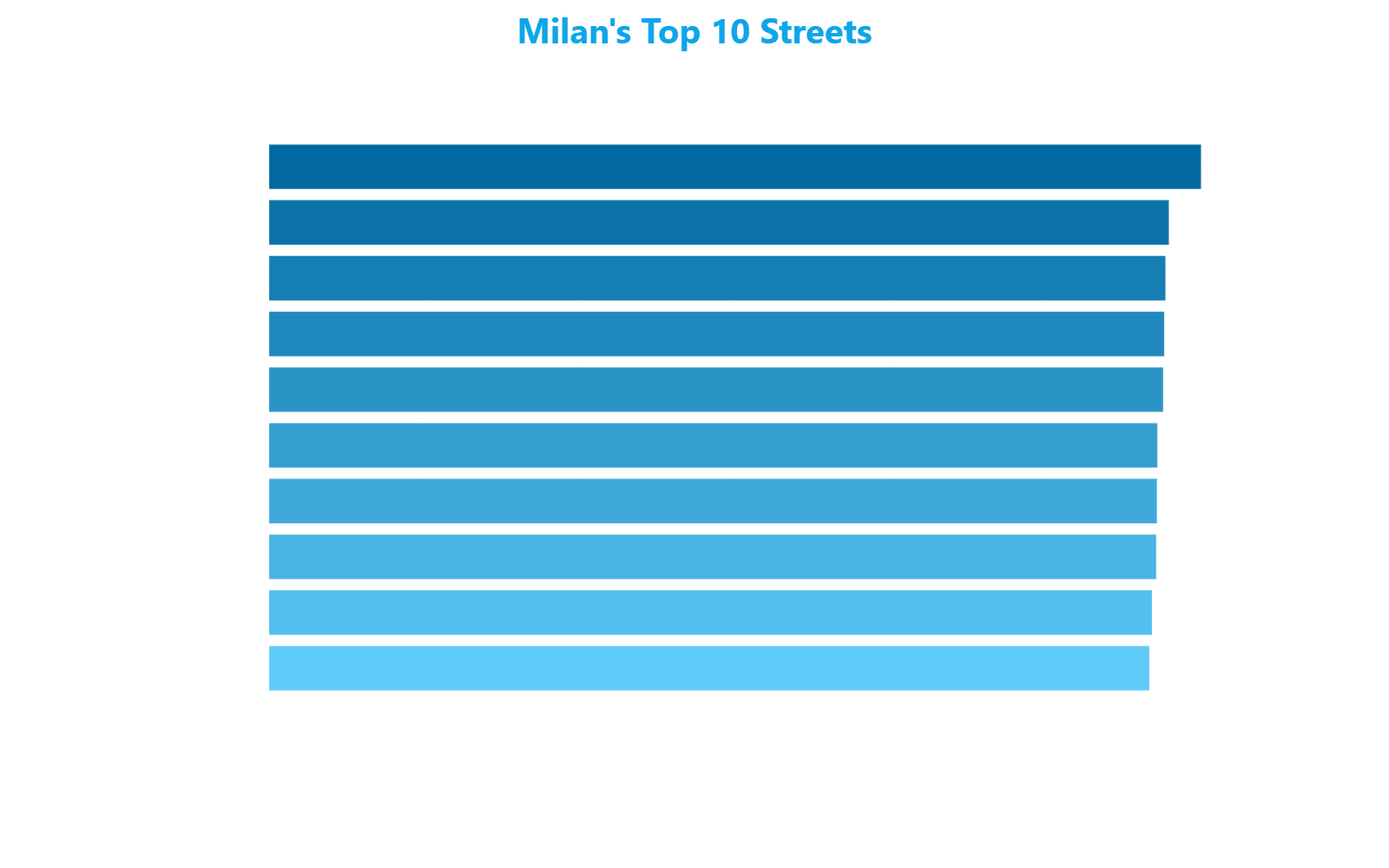
The podium: three different paths to excellence
This ranking rewards consistency, not peaks. The CityAdvisor Index is the weighted average of ten macro indicators — Urban Development, Urban Livability, Real Estate Value, Safety, Attractiveness, Transport, Retail Offering, Profitability, Social Infrastructure, and Demographics — and those at the top score well across all of them simultaneously. Dominating a single dimension is not enough: what matters is cross-cutting strength across every metric.
Galleria Anna Castelli Ferrieri has held the top spot for at least four years, and was already in the top 5 five years ago. From 56.55 to 60.03 points: a gradual gain of 3.48 points that consolidated its lead without any sudden jumps. This trajectory signals a structural position, not a temporary anomaly.
In second place, Piazza Sei Febbraio (Sempione) at 57.96 points — more than 15 points above the citywide median. Its climb was steeper: five years ago it ranked 58th, three years ago it had already entered the top 10, and over the past two years it has stabilized in the top five. A trajectory of ascent that progressively consolidated.
Via Giovanni da Procida, also in Sempione, rounds out the podium at 57.74 points. Here too, the historical profile tells a clear story: from 18th place five years ago to 4th three years ago, and now third. The climb happened in the first three years; from that point on, stabilization at the top.
How much has the top 3 grown over the past five years?
All three leading streets followed a multi-year growth path. Galleria Anna Castelli Ferrieri rose from 56.55 to 60.03 points, Piazza Sei Febbraio climbed from 58th position to second place, and Via Giovanni da Procida from 18th to third. None of them is a recent arrival: their consolidation at the top happened gradually, over a span of at least three to five years.
Two remarkable climbers
Among the ten, two streets traveled the longest path. Via Plutarco (City Life), now fourth at 57.66 points, ranked 83rd five years ago. Via Sofocle, in the same area, jumped from 118th to fifth position. Both gained over 80 places in five years — an ascent reflecting the transformation of the City Life area and its impact on surrounding urban fabric, documented by sources specialized in urban development.
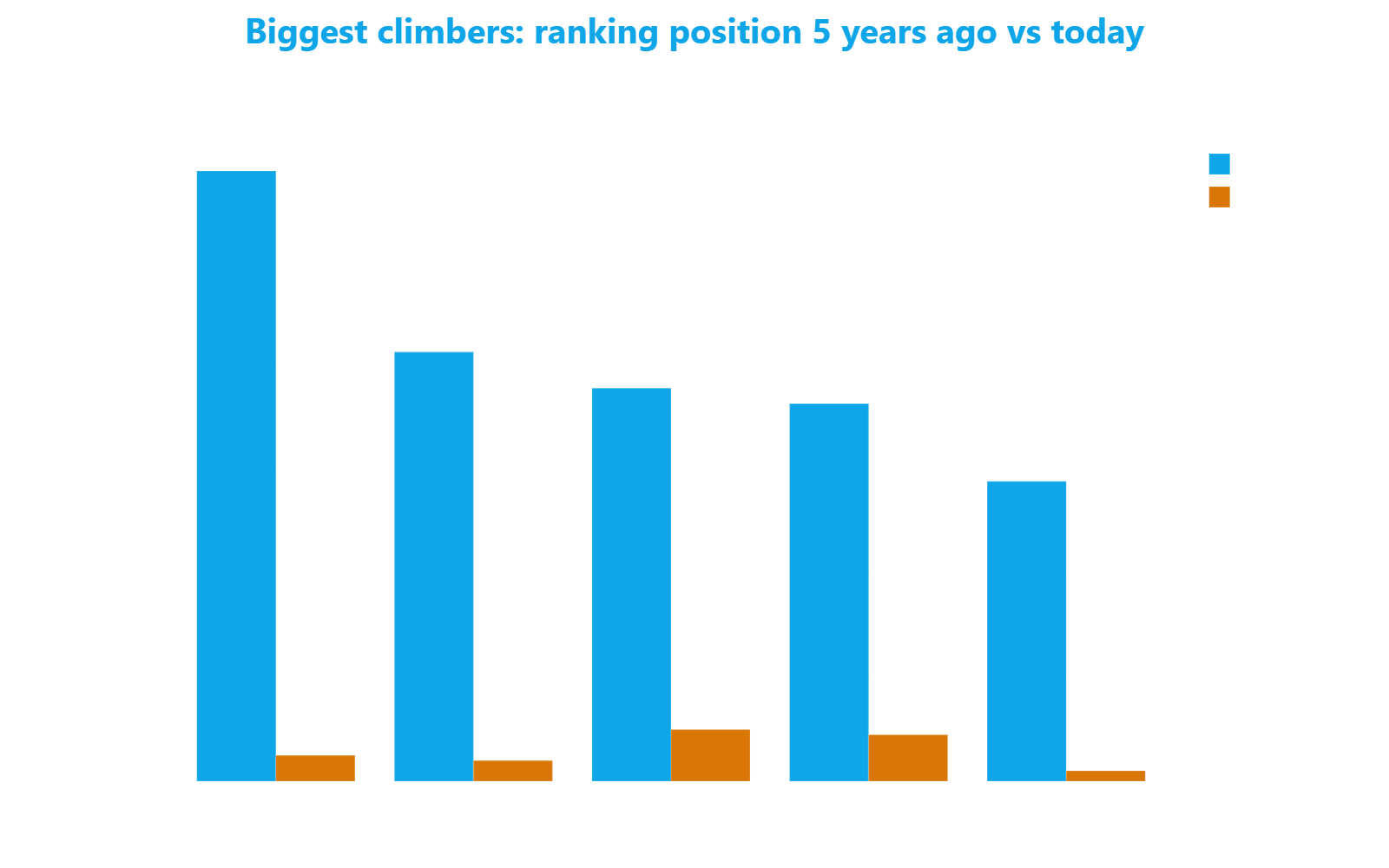
The contrast lies with Viale Eginardo (Monte Rosa - Lotto), which held a steady second-to-third position for five years and now slips to seventh. Not a collapse: its score rose from 57.15 to 57.19. But surrounding streets climbed faster, and in a relative ranking that is enough to lose ground.
What explains the rise of Via Plutarco and Via Sofocle?
The gain of over 80 positions in five years is tied to the urban transformation of City Life, which simultaneously improved multiple dimensions: Real Estate Value, Retail Offering, Social Infrastructure, and Attractiveness. The CityAdvisor Index, as a multi-dimensional weighted average, rewards precisely those who grow on multiple fronts at once.
The top 10 pattern
The ranking's geography is the most telling fact. Four out of ten streets belong to City Life (Galleria Castelli Ferrieri, Via Plutarco, Via Sofocle, Largo Domodossola), five to Sempione (Piazza Sei Febbraio, Via Giovanni da Procida, Viale Duilio, Viale Severino Boezio, Via Giovanni Prati). A single entry from Monte Rosa - Lotto, Viale Eginardo. The entire top 10 fits within an approximately two-kilometer corridor in the city's northwest.
The spread between first and tenth is 3.33 points — narrow in absolute terms. But the gap from the citywide median is striking: even the last on the list, Via Giovanni Prati at 56.70 points, exceeds the median by nearly 14 points. This is not a ranking with one winner and nine also-rans: it is a homogeneous group of excellence, sharply separated from the rest of the city's distribution.
Why is the top 10 concentrated between City Life and Sempione?
The two areas share structural characteristics that the CityAdvisor Index captures across multiple dimensions: high Real Estate Value supported by listings from real estate portals and a proprietary multi-source model, strong Transport connectivity, high-quality Retail Offering based on geospatial business activity data, and Safety and Livability profiles above the citywide average. The geographic concentration reflects a cumulative advantage across all ten macro indicators.
The historical thread confirms this solidity: none of the ten streets is a newcomer from the past year. All were already in the top 20 twelve months ago. The ranking of Milan's best streets, at least on this composite index calculated from 105 metrics with monthly data going back to January 2020, changes slowly — and when it does, it rewards those who grow across multiple dimensions simultaneously.
Methodology: ranking based on the CityAdvisor Index, a weighted average of 10 macro indicators calculated across 4,006 Milan streets. Period: March 2026. The index integrates Urban Development, Urban Livability, Real Estate Value, Safety, Attractiveness, Transport, Retail Offering, Profitability, Social Infrastructure, and Demographics, with differentiated weights. Data from public and proprietary sources, covering 4,006 streets, 105 metrics, and monthly historical series since January 2020.
Frequently Asked Questions
What is the best street in Milan according to the CityAdvisor Index?
Galleria Anna Castelli Ferrieri, in the City Life neighborhood, holds the top spot with 60.03 points — the only street in Milan to exceed the 60-point threshold. This lead has been stable for at least four years and rests on high scores across all ten dimensions of the index, from Safety to Real Estate Value.
How many dimensions does the CityAdvisor Index consider?
The CityAdvisor Index is the weighted average of ten macro indicators: Urban Development, Urban Livability, Real Estate Value, Safety, Attractiveness, Transport, Retail Offering, Profitability, Social Infrastructure, and Demographics. Each macro indicator is computed from a total of 105 metrics, with data updated monthly since January 2020.
What is the average score of Milan's streets?
The citywide median of the CityAdvisor Index stands at 42.87 points across 4,006 streets analyzed. The ten streets at the top of the ranking all exceed 56 points, with a gap from the median ranging from nearly 14 to over 17 points — a highly significant margin in a compact distribution.
In which neighborhoods are Milan's best streets located?
Nine out of ten streets in the ranking are located between City Life and Sempione, a corridor of roughly two kilometers in northwest Milan. City Life accounts for four entries and Sempione for five. The sole exception is Viale Eginardo, in the Monte Rosa - Lotto neighborhood.
Does the best streets ranking change over time?
The ranking changes slowly. All streets currently in the top 10 were already in the top 20 twelve months ago. The most significant movements over the past five years involved Via Plutarco and Via Sofocle, which climbed from 83rd and 118th position respectively, driven by the urban transformation of City Life.