Porta Nuova: Milan's most transformed skyline, with Safety and returns lagging behind
A deep-dive into the Porta Nuova neighborhood — 20 metrics, 15 streets, 144 neighborhoods compared. Data from March 2026.
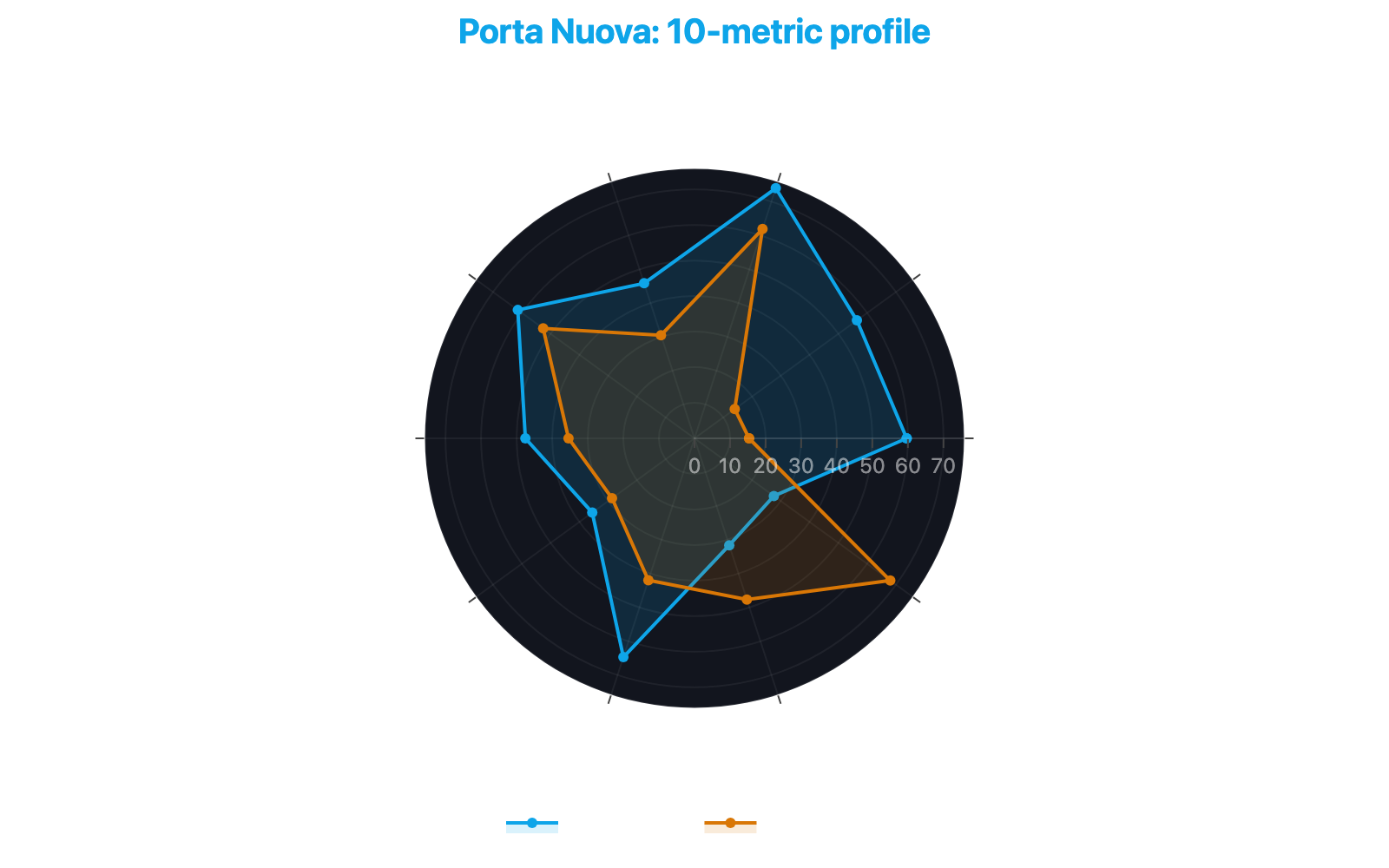
Porta Nuova is the Milan neighborhood that has undergone the most radical physical transformation over the past decade, reshaping real estate prices in Porta Nuova and the entire urban dynamic of the area. With 59.66 points in Urban Transformation — fifth out of 144 neighborhoods, more than triple the city median of 15.34 — and 56.44 points in Urban Development, it ranks among the very few areas in Milan where urban regeneration has reached a systemic scale. Yet on Safety and Profitability, Porta Nuova sits among the worst-performing neighborhoods in the city.
A neighborhood redesigned
The density of completed interventions in the area is among the highest in Milan. The residential towers of Solaria, Solea and Aria, Torre Diamante, Torre Unipol and the Biblioteca degli Alberi form an urban fabric that did not exist fifteen years ago. Development has not stopped: nearby, the Vespucci 2 The Shred project — 12,300 square meters of residential development — is expected to be completed by 2026, while a tertiary refurbishment on Corso di Porta Nuova is scheduled for mid-year. The platform contains the datasheet for every urban development project within range of the street: classification, size, stakeholders, progress status and timeline, based on data collected from sources specialized in urban development.
The physical outcome is visible in the numbers. Urban Decorum reaches 73.95 points, eleventh out of 144 neighborhoods and well above the city median of 61.89. Aesthetics scores 45.84 points — twenty-first neighborhood, nearly 40% above the median of 30.50 — driven by the concentration of prestige buildings and contemporary architecture, as confirmed by automated street-level image analysis. Road Maintenance stands at 61.40 points, in the city's top 10%.
How much has Porta Nuova changed in the last ten years?
Porta Nuova scored 59.66 points in Urban Transformation, ranking fifth among Milan's 144 neighborhoods. This figure is more than triple the city median of 15.34 points, confirming an urban regeneration process that has reached systemic scale, with further interventions still underway through late 2026.
The price without the return
The baseline purchase price stands at 8,848 euros per square meter — a figure that can fluctuate by 30% for individual properties depending on floor, condition and amenities, according to the proprietary multi-source model that integrates institutional valuations, recent transactions and listing prices. This is more than double the city median of 4,190 euros, placing the neighborhood fifteenth out of 144. A level consistent with the demographic profile: average income is 78,166 euros, nineteenth neighborhood in Milan, according to IRPEF tax filings.
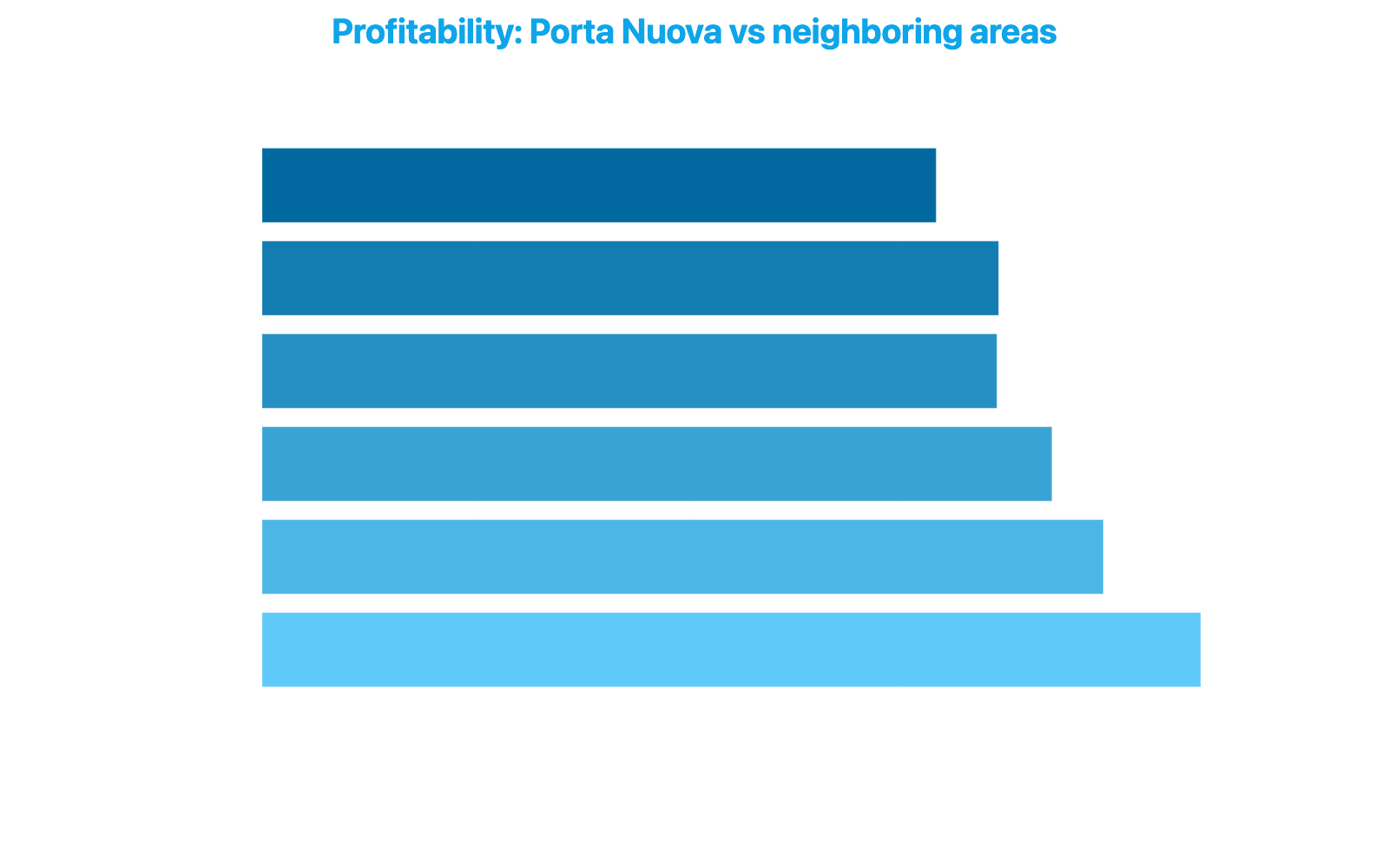
But returns tell a different story. Profitability scores 31.61 points — 141st out of 144 neighborhoods, in the absolute bottom 3% of the city. The net long-term rental yield stops at 2.21%, one of the lowest in Milan, despite rents that are far from negligible: 1,788 euros per month for a one-bedroom apartment. The problem is structural: the entry price is so high that rents, while elevated in absolute terms, do not generate a proportional return. Compared to its neighbors, Porta Nuova ranks last: Melchiorre Gioia reaches 44.02 points in Profitability, Repubblica 39.45, Garibaldi - Corso Como 37.04.
Is it worth investing in property in Porta Nuova?
With an average price of 8,848 euros per square meter and a net rental yield of 2.21%, Porta Nuova sits in the bottom 3% of Milan for Profitability. Rental income is high in absolute terms — 1,788 euros per month for a one-bedroom apartment — but the entry price compresses the return. Investment viability should be assessed on a case-by-case basis.
The Safety problem
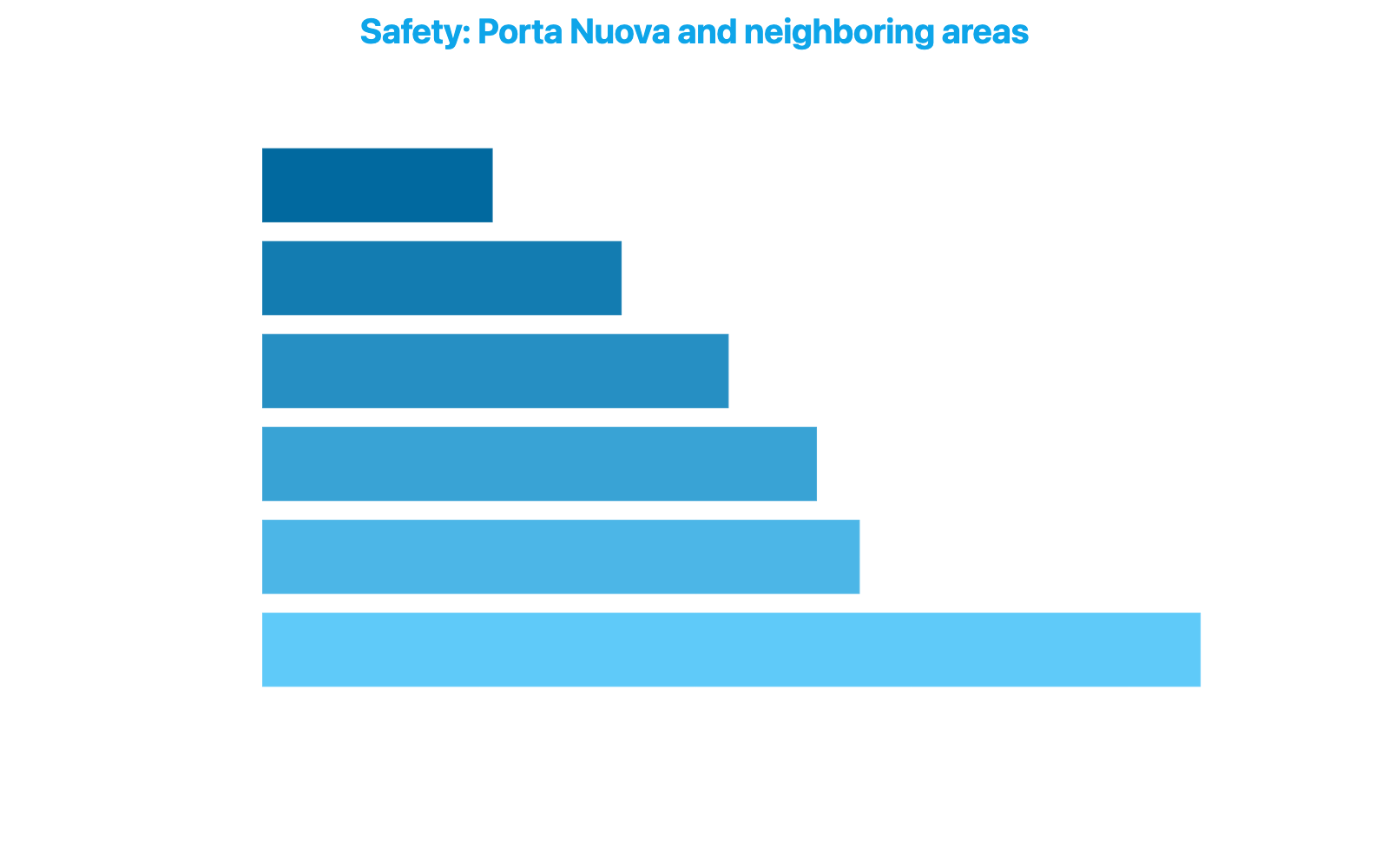
The Safety index stands at 27.58 points — 133rd out of 144 neighborhoods, in the bottom 8% of Milan, versus a city median of 68.03. The Safety analysis is based on 27 crime categories monitored street by street — all available in detail on the platform, with type, frequency and trend data. The figure is not uniform within the neighborhood: it ranges from 49.20 points in Piazza Stati Uniti d'America to 11.20 in the least safe street, a 38-point spread that reveals strong internal heterogeneity. Among neighbors, only Garibaldi - Corso Como (10.64) and Repubblica (16.59) fare worse.
Is Porta Nuova a safe neighborhood?
No. Porta Nuova's Safety index is 27.58 out of 100, ranking 133rd out of Milan's 144 neighborhoods. The figure varies considerably within the area, with a 38-point range between the safest and least safe streets. Among neighboring areas, only Garibaldi - Corso Como and Repubblica record lower values.
A patchy Retail Offering
Retail Offering scores 35.53 points — thirty-fourth neighborhood, above the median of 28.66 — but with an internal range of 55.86 points, the widest spread among all metrics, based on geospatial surveys of commercial activities. Via Amerigo Vespucci and Via Filippo Turati exceed 55 points, while three streets in the neighborhood register a Retail Offering of zero. A neighborhood where commercial vitality concentrates on a few axes, leaving large residential zones without proximity services.
The profile
Porta Nuova is the case study of an exceptional-scale urban transformation that has produced an aesthetically prestigious and physically modern neighborhood, but where Safety and Profitability remain structural weaknesses. The gap between price levels — top 10% — and net yield — bottom 3% — is a figure that questions the economic sustainability of residential investment, to be assessed on a case-by-case basis.
Methodology: monograph based on 20 metrics calculated across 144 Milan neighborhoods. Period: March 2026. Rankings indicate position in the city distribution (1 = highest value). Data from public and proprietary sources, covering 4,006 streets, 105 metrics and monthly history from January 2020.
Frequently Asked Questions
What is the average price per square meter in Porta Nuova?
The baseline purchase price in Porta Nuova stands at 8,848 euros per square meter, more than double the city median of 4,190 euros. The figure for individual properties can fluctuate by 30% depending on floor, condition and amenities. This places the neighborhood fifteenth out of Milan's 144 neighborhoods.
How much does a one-bedroom apartment rent for in Porta Nuova?
A one-bedroom apartment in Porta Nuova generates an average rent of 1,788 euros per month, but the net long-term rental yield stops at 2.21%. The neighborhood's overall Profitability score is 31.61 points, 141st out of 144, in the city's bottom 3%. The high entry price compresses the return on investment.
How safe is Porta Nuova compared to the rest of Milan?
Porta Nuova's Safety index is 27.58 points versus a city median of 68.03, placing the neighborhood 133rd out of 144. Within the area, the situation is heterogeneous, with a 38-point range between the safest and least safe streets. The analysis covers 27 crime categories monitored street by street.
Are there new urban development projects coming to Porta Nuova?
Yes. The Vespucci 2 The Shred project, with 12,300 square meters of residential development, is expected to be completed by 2026. A tertiary refurbishment on Corso di Porta Nuova is also scheduled for mid-year. The neighborhood already scores 59.66 out of 100 in Urban Transformation, fifth among Milan's 144 neighborhoods.