Milan, March 2026: the 10 streets that lost the most positions in the CityAdvisor Index over 12 months
Which streets slid the furthest in the overall urban competitiveness ranking between March 2025 and March 2026 — and what they have in common
Over one thousand positions lost in twelve months. Via Francesco Paolo Michetti, in the Bovisa neighborhood, recorded the sharpest drop in the entire ranking: from 44.09 to 41.31 points on the CityAdvisor Index — a 2.8-point decline that, in a citywide distribution where the median stands at 42.87, marks a shift from the upper half to the lower half of the table. The streets losing the most positions in the CityAdvisor Index in Milan reveal urban transformation dynamics worth watching. And this is no isolated case: four of the ten streets with the worst decline belong to the same neighborhood.
Bovisa: four streets in free fall
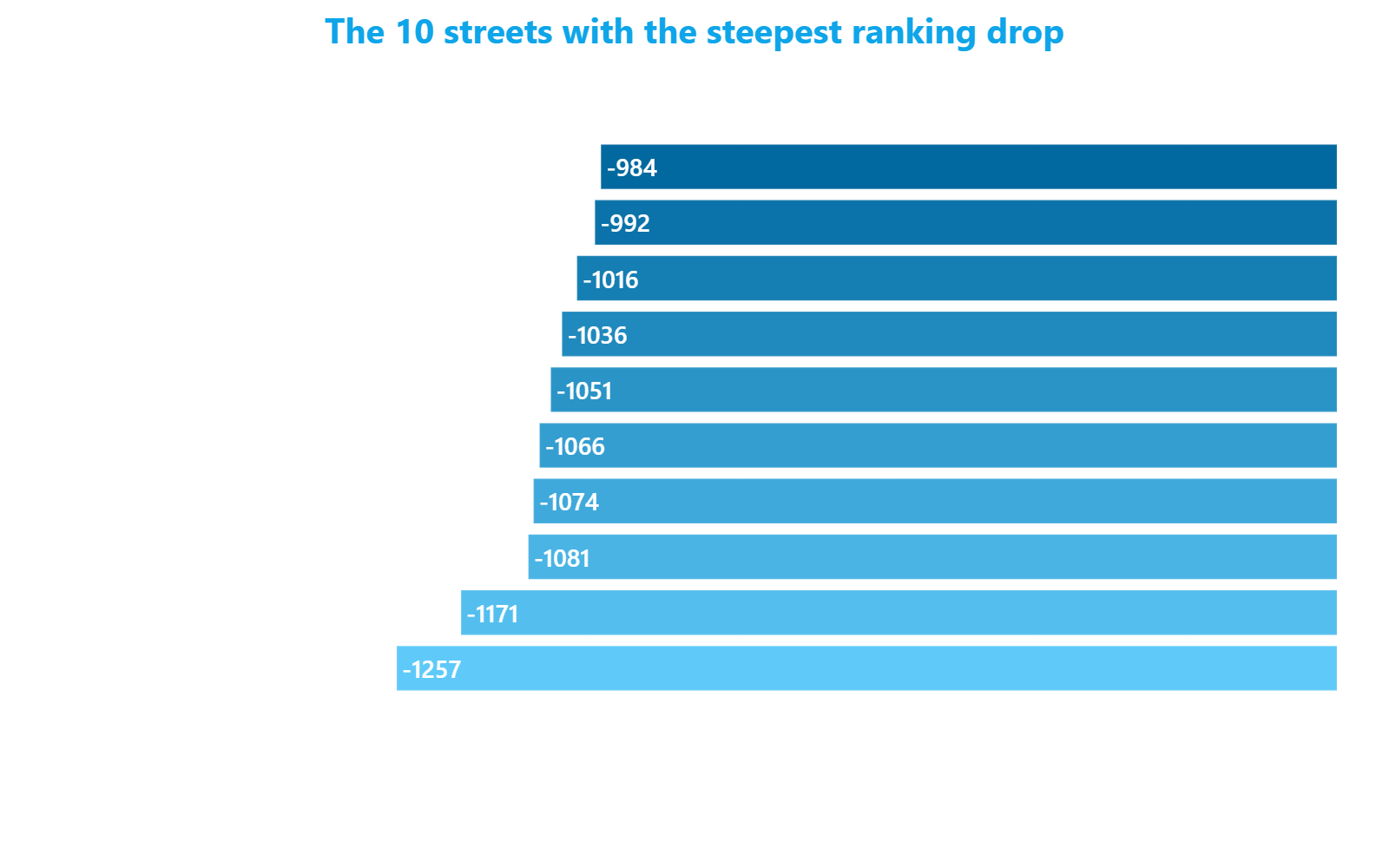
The most striking pattern is geographic. Via Michetti (-1,257 positions), Via Benedetto Varchi (-1,171), Via Rosa Massara de Capitani (-1,081) and Via Giovanni Arrivabene (-1,051) form a cluster concentrated in Bovisa. Point drops range between 2.3 and 2.8 — modest in absolute terms, but the CityAdvisor Index is a highly compact composite indicator, with a standard deviation of just 4.15 points across 4,006 streets. In such a dense ranking, losing 2-3 points means sliding past hundreds of positions.
Via Varchi, at 40.10 points, now sits nearly three points below the city median, placing it in the lower portion of the ranking at position 3,026 out of 4,006. Via Arrivabene moved from position 1,621 to 2,672: once in the upper half, it now falls in the bottom third.
The CityAdvisor Index aggregates ten Macro Indicators — from Urban Development to Real Estate Value, from Safety to Urban Livability — weighted by relevance through a proprietary multi-source model integrating institutional valuations, geospatial commercial activity data, municipal demographic records and vehicular traffic measurements. A simultaneous deterioration across this index signals that the decline is not confined to a single dimension but cuts across multiple components of urban competitiveness.
Why is Bovisa losing positions in the CityAdvisor Index?
Four Bovisa streets rank among the city's ten worst for ranking decline. Drops between 2.3 and 2.8 points indicate a cross-cutting deterioration across multiple Macro Indicators of urban competitiveness — not an isolated decline on a single dimension.
The historic center surprise
While Bovisa accounts for the highest concentration of declining streets, central Milan is not immune. Piazza Belgioioso and Via degli Omenoni — both in the heart of the Scala-Manzoni quadrilateral — lost 1,074 and 1,066 positions respectively over twelve months. Piazza Belgioioso dropped from 44.91 to 42.50 points, slipping just below the median. Via degli Omenoni, which a year ago scored 45.27 points and ranked among Milan's top 935 streets, fell to position 2,001 with 42.87 points — landing exactly on the city median.
In a context where the citywide median delta is just -9 positions, drops of this magnitude in the historic center are a rare and significant signal.
How much has Milan's historic center dropped in the ranking?
Piazza Belgioioso and Via degli Omenoni, in the Scala-Manzoni quadrilateral, each fell more than one thousand positions in twelve months. Piazza Belgioioso dropped from 44.91 to 42.50 points, Via degli Omenoni from 45.27 to 42.87 — an anomalous result for the historic center, where the citywide median delta is just -9 positions.
The group profile
The remaining four streets complete a picture spread across different neighborhoods. Via Marco Fabio Quintiliano (Viale Ungheria-Mecenate, -1,036 positions) and Via Popoli Uniti (Rovereto, -1,016) represent the eastern and northeastern periphery. Via Stampa (Carrobbio, -992) and Via Alfredo Oriani (Quadronno-Crocetta, -984) belong to the southern semi-center, where a 2.2-2.3 point drop pushed streets that previously sat in the upper tier — positions 875 and 919 — past the 1,900 threshold.
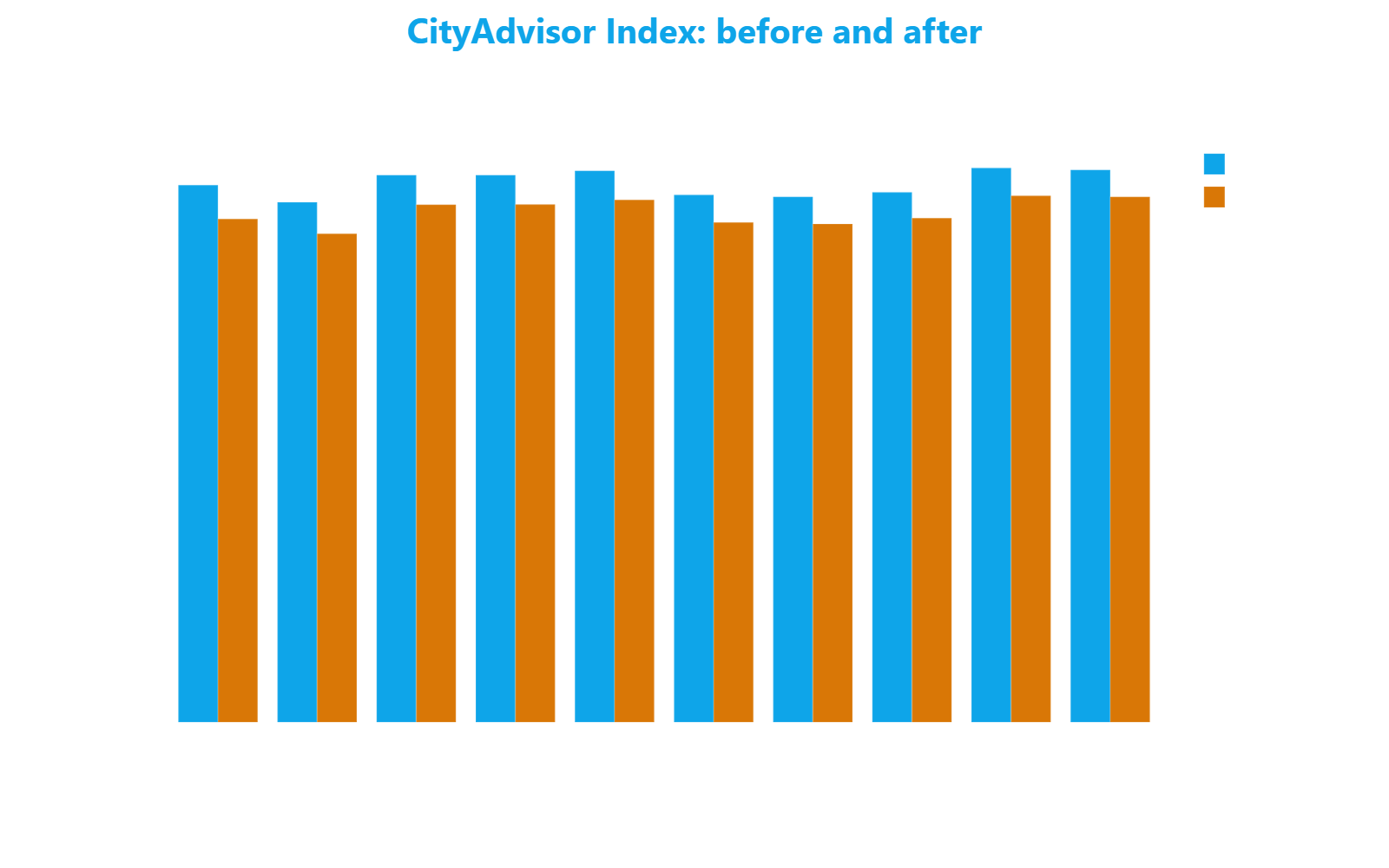
What unites all ten streets is the disproportion between the point decline and the ranking shift. None lost more than 2.8 points, yet all dropped at least 984 positions. This is the effect of the CityAdvisor Index's compactness: when the gap between one position and the next is measured in hundredths of a point, even a moderate decline in fundamentals translates into a wide slide in the ranking. A figure, calculated as the change in relative position across 4,006 streets monitored monthly, that calls into question the stability of these streets across multiple dimensions simultaneously — warranting closer investigation on a case-by-case basis.
Methodology: ranking change across 4,006 streets between March 2025 and March 2026 (12 months). The CityAdvisor Index is the weighted average of 10 Macro Indicators of urban competitiveness. The ranking measures relative position: a decline indicates deterioration compared to other streets. Data from public and proprietary sources, covering 4,006 streets, 105 metrics and a monthly time series from January 2020.
Frequently Asked Questions
Which street lost the most positions in Milan over 12 months?
Via Francesco Paolo Michetti, in the Bovisa neighborhood, recorded the steepest decline: -1,257 positions in the CityAdvisor Index ranking between March 2025 and March 2026, dropping from 44.09 to 41.31 points. A 2.8-point decline that, in the index's compact distribution, moved it from the upper half to the lower half of the ranking.
Why does a drop of just 2-3 points translate into over a thousand positions lost?
The CityAdvisor Index has a standard deviation of just 4.15 points across 4,006 streets. This means the gap between one position and the next is often measured in hundredths of a point. In such a dense ranking, even a moderate decline in fundamentals triggers a slide of hundreds of positions.
Which Milan neighborhoods have the steepest-declining streets?
Bovisa is the hardest-hit neighborhood, with four streets among the ten worst. But the phenomenon is not limited to the periphery: the historic center (Piazza Belgioioso and Via degli Omenoni, in the Scala-Manzoni quadrilateral) also recorded drops exceeding one thousand positions. The remaining streets are spread across Viale Ungheria-Mecenate, Rovereto, Carrobbio and Quadronno-Crocetta.
How many streets and metrics does the CityAdvisor Index cover?
The CityAdvisor Index covers 4,006 Milan streets, monitored monthly since January 2020. It integrates 105 metrics organized into 10 Macro Indicators of urban competitiveness — including Urban Development, Real Estate Value, Safety and Urban Livability — calculated from public and proprietary sources.
Is Milan's historic center really declining?
Two historic center streets, Piazza Belgioioso and Via degli Omenoni, each lost over one thousand positions in twelve months. In a context where the citywide median delta is just -9 positions, this is a rare signal. Via degli Omenoni went from ranking among the top 935 streets to position 2,001, landing exactly on the median of 42.87 points.