Retail Offering in Milan, April 2026: the streets that climbed the ranking in one month
Analysis of 4,006 streets: where the mix of shops, restaurants, and hospitality venues changed the most between March and April 2026.
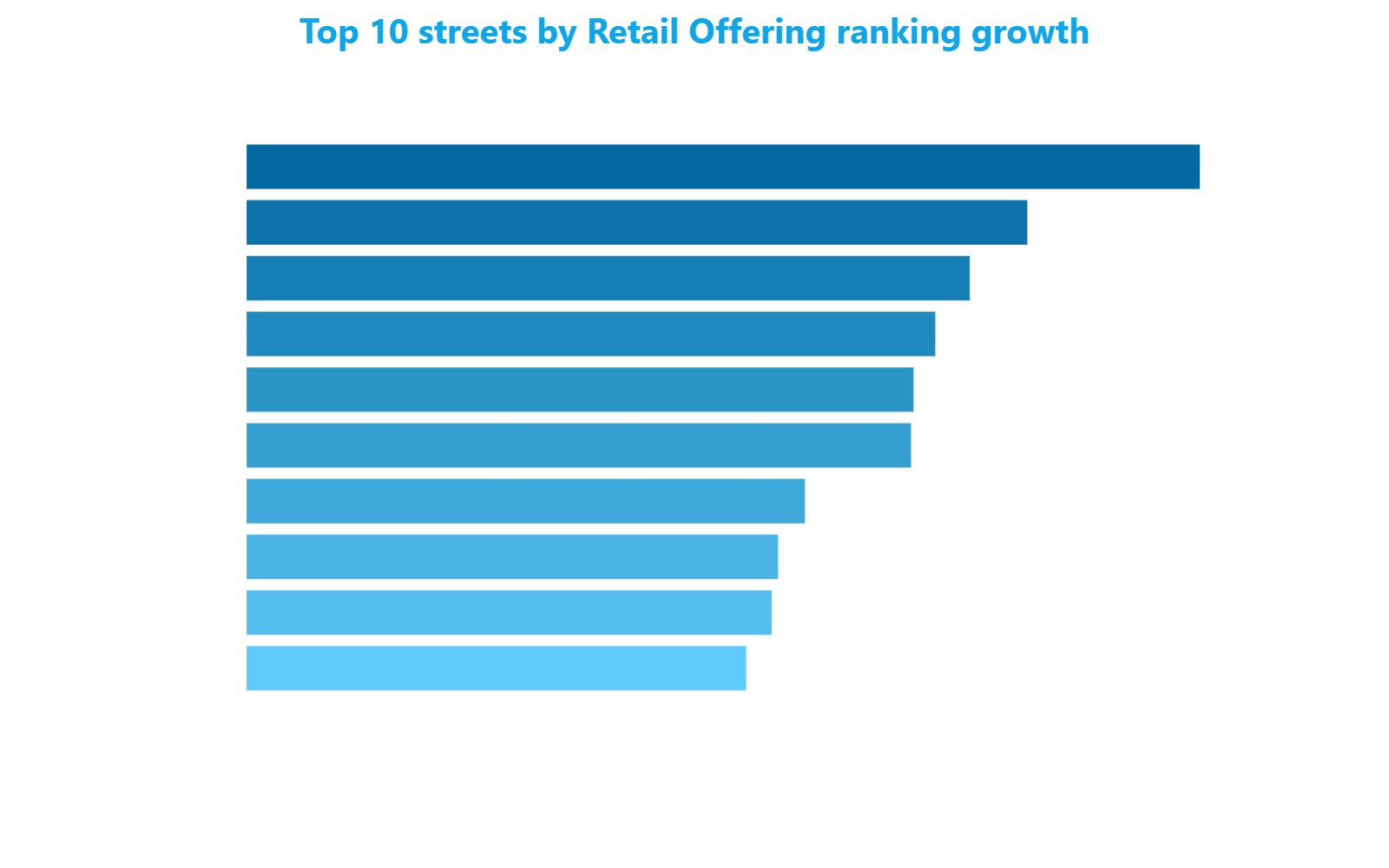
Milan's Retail Offering shifts month by month, and April 2026 data captures significant movements. In just one month, Via Cordusio climbed 746 positions in the Retail Offering ranking, the largest leap between March and April 2026 across 4,006 streets monitored through geospatial commercial activity surveys. The jump brought it from the lower half of the table into the top third, with a score rising from 36.02 to 42.44 points -- now seven points above the city-wide median of 35.28.
Via Cordusio and Via Circo: the historic centre on the move
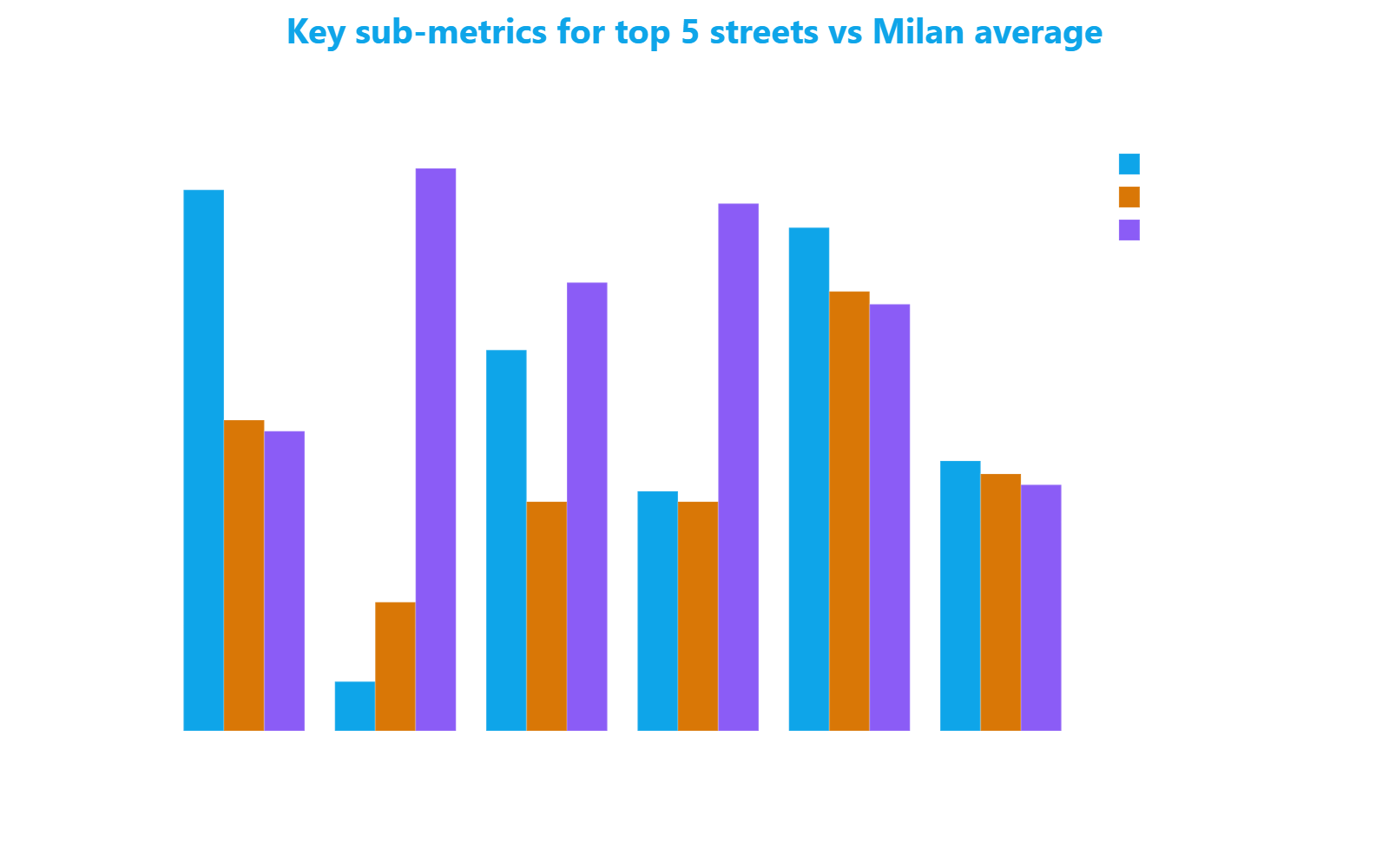
Via Cordusio, in the heart of Duomo, combines a Shop Density score of 51.70 -- double the city average of 25.80 -- with a Historic Shop and a hotel. The ranking jump reflects the strengthening of a retail mix that was already above average, not an emergence from nothing.
More striking is Via Circo in Carrobbio, which appears in two rankings simultaneously: +522 positions in Retail Offering and +656 in restaurants, having gone from zero to one surveyed restaurant. Via Circo's Commercial Diversity reaches 42 points -- nearly double the city average of 24.55 -- and the street counts three Historic Shops, five times the Milan average. A Shop Density of 48.10 points rounds out the profile of a street building a diverse and deeply rooted retail fabric.
Which Milan streets improved their Retail Offering the most in April 2026?
Via Cordusio leads with 746 positions gained in one month, followed by Viale Berbera in Niguarda (+566), Via Circo in Carrobbio (+522), and Via Privata Alessandro Scanini in Baggio (+519). The data comes from monthly monitoring of 4,006 streets, based on a composite index that integrates density, diversity, quality, and positioning of commercial activities.
Signals of transformation from the outskirts
Two streets started from zero: Via Privata Alessandro Scanini in Baggio and Via Luigi Brugnatelli in Barona. Neither had any surveyed commercial activities in March; they now register 32.01 and 30.40 points respectively -- just below the city median, but enough to gain over 500 positions each. These are true emergences: the first recorded retail presence where none existed before.
Via Livio Cambi in Gallaratese also shows a dual movement: +437 in Retail Offering and +656 in restaurants. With a Shop Density of 39 points, a hotel, and a newly surveyed restaurant, this Gallaratese street confirms that signs of commercial vitality are not confined to the centre.
Is Retail Offering improving only in central Milan?
No. April 2026 data shows significant movements in outer neighbourhoods as well: Via Privata Alessandro Scanini in Baggio (+519 positions) and Via Luigi Brugnatelli in Barona (+505) went from zero surveyed commercial activities to scores near the city median. Via Livio Cambi in Gallaratese and Via Don Francesco Beniamino della Torre in Quarto Oggiaro confirm that commercial vitality extends across the entire city.
The group: patterns and details
Viale Berbera in Niguarda (+566) and Via Rastrelli in Duomo (+539) complete the upper part of the ranking. Via Rastrelli stands out for three Historic Shops and a Shop Ratings score of 50.40 -- more than double the city average of 23.52 -- a sign of quality retail. Via Giovenale, in the Corso San Gottardo area (+411), has two restaurants, nearly double the city average of 1.13, and the highest Shop Ratings in the group at 52.98 points.
Via Ruggero Bonghi in Pezzotti-Meda (+416) is the only top-10 street with both a nightclub and a hotel, while Via Don Francesco Beniamino della Torre in Quarto Oggiaro (+391) closes the ranking, bringing a signal of movement from the far northern periphery.
Restaurants, nightlife, and hotels: the context
The other three metrics -- restaurants, nightlife, and hotels -- show a uniform pattern: every street on the list went from zero to one unit. For restaurants, the leap is worth 656 positions; for nightlife venues 324; for hotels 492. Notable new entries include Via Fiori Chiari in Brera and Bastioni di Porta Volta in Paolo Sarpi for nightlife, and Via Eugenio Villoresi in Navigli and Via San Giovanni sul Muro in Duomo for hotels. In a city where the median is zero for all three metrics, going from no activity to just one is enough to enter the upper half of the ranking.
Methodology: ranking variation across 4,006 streets between March and April 2026 (1 month). Each metric analysed independently. Retail Offering is a composite index integrating density, diversity, quality, and positioning of commercial activities, calculated from geospatial commercial activity surveys. The ranking measures relative position: a rise indicates improvement compared to other streets. Data from public and proprietary sources, covering 4,006 streets, 105 metrics, and monthly records since January 2020.
Frequently Asked Questions
What does the Milan Retail Offering index measure?
The Retail Offering index is a composite score integrating density, diversity, quality, and positioning of commercial activities for each street. It is calculated monthly across 4,006 Milan streets using geospatial commercial activity surveys and proprietary multi-source data. The city-wide median in April 2026 is 35.28 points.
Did Via Cordusio really gain 746 positions in one month?
Yes. Between March and April 2026, Via Cordusio moved from the lower half of the table into the top third, with its score rising from 36.02 to 42.44 points. The jump reflects the strengthening of a retail mix on a street that already had double the city-average commercial activity density.
Which outer neighbourhoods show commercial growth in April 2026?
Data records significant emergences in Baggio (Via Privata Alessandro Scanini, +519 positions), Barona (Via Luigi Brugnatelli, +505), Gallaratese (Via Livio Cambi, +437), and Quarto Oggiaro (Via Don Francesco Beniamino della Torre, +391). In all cases, these are streets where surveyed commercial activities appeared for the first time or the existing mix was strengthened.
How does a street enter the upper half of the restaurant ranking in Milan?
In a city where the median number of restaurants per street is zero, going from no surveyed restaurant to just one is enough to gain 656 positions and land in the upper half of the ranking. This is the case for Via Circo in Carrobbio, Via Livio Cambi in Gallaratese, and other streets monitored in April 2026.