Via Padova: Crescenzago's top retail street, Milan's least safe
A deep dive into Via Padova in Crescenzago. With the highest Shop Density in its neighborhood but the lowest Safety score among 4,006 Milan streets, the data reveals a street where commercial vitality clashes with urban decay.
Via Padova scores zero on the safety index -- the lowest value among 4,006 monitored streets, based on 27 crime categories tracked through systematic news analysis. Yet it ranks third in the Crescenzago neighborhood for Retail Offering, with a Shop Density of 58.10 points against a citywide average of 25.76 and a Commercial Diversity score of 87.20 -- more than three and a half times the Milan average. This contrast defines Via Padova: a busy, vibrant thoroughfare where commerce thrives in a context that, on nearly every other dimension, registers among the city's lowest scores.
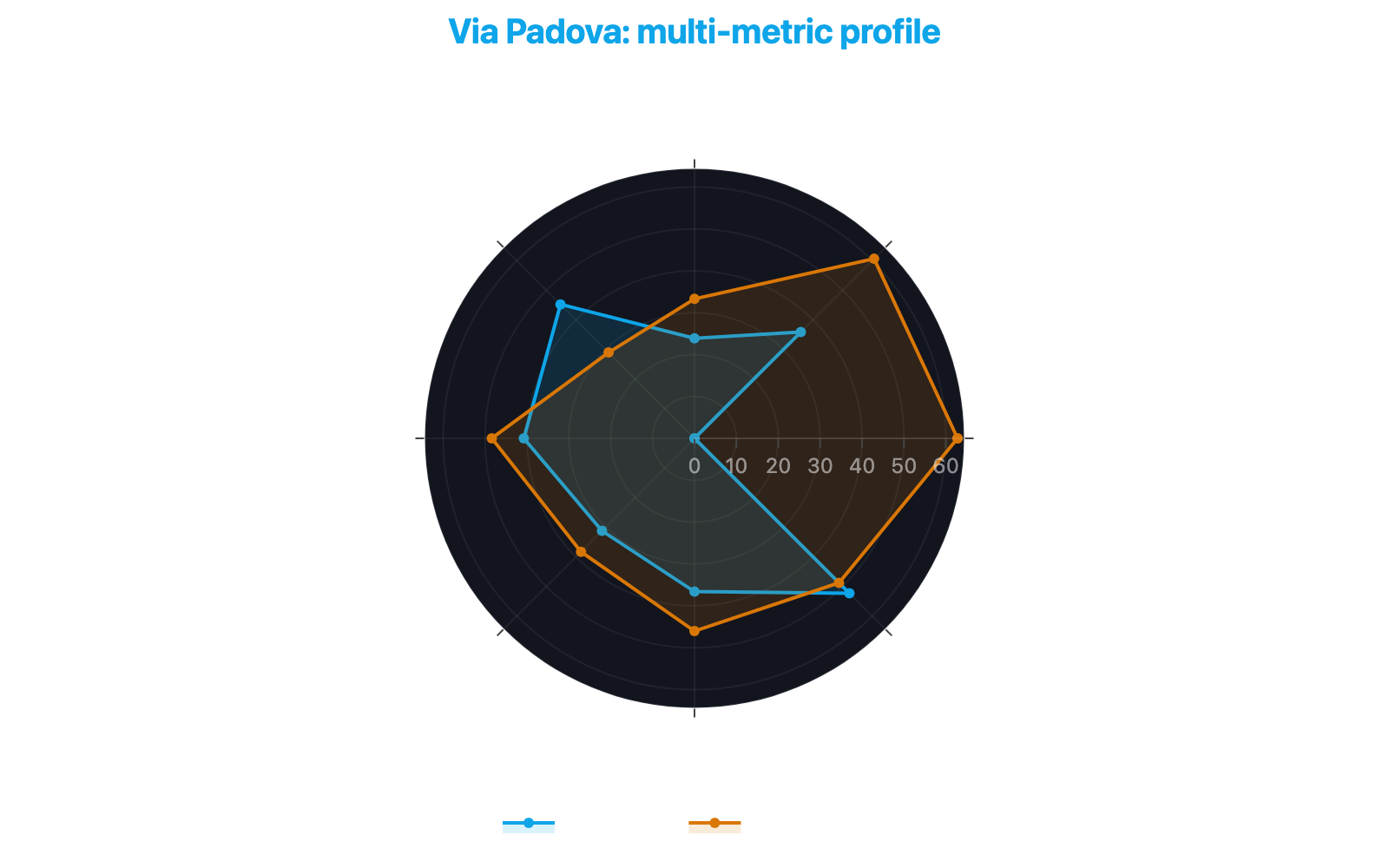
Dense retail, low-cost positioning
Shop Density places Via Padova in the top 21% of Milan. Fifty restaurants, six nightlife venues, five historic shops, two hotels and two artisan workshops make up a remarkably diverse retail fabric, according to geospatial surveys of commercial activities. But Retail Positioning tells a different story: 21.30 points, a score signaling the dominance of the low-cost segment -- discount stores, minimarkets, money transfer outlets -- with no recognized brands present. The street is commercially dense, not commercially upscale.
How many shops are there on Via Padova?
Via Padova hosts over fifty restaurants, six nightlife venues, five historic shops, two hotels and two artisan workshops. With a Shop Density of 58.10 points and a Commercial Diversity of 87.20 -- more than three and a half times the citywide average -- it ranks third in Crescenzago for Retail Offering and sits in the top 21% of Milan.
The weight of decay
Urban Decorum scores 35.89 points against a citywide median of 64.17 -- nearly half. The data comes from automated street-level image analysis, which measures the visual condition of the urban environment systematically. Among the eight nearest streets, Via Bengasi reaches 80.35 and Via Pietro Toselli 71.81: the visual decay of Via Padova is not a neighborhood trait -- it is specific to this street. Aesthetics confirms the picture: 23.89 points against a median of 31.64, in the bottom 22% of the city.
The Safety analysis is based on 27 crime categories monitored street by street, reconstructed through news sources -- all available in detail on the platform, with type, frequency and trend. Via Padova's score is the most critical in the entire dataset: zero points, against a 32.39 average among neighboring streets and a citywide median of 65.05.
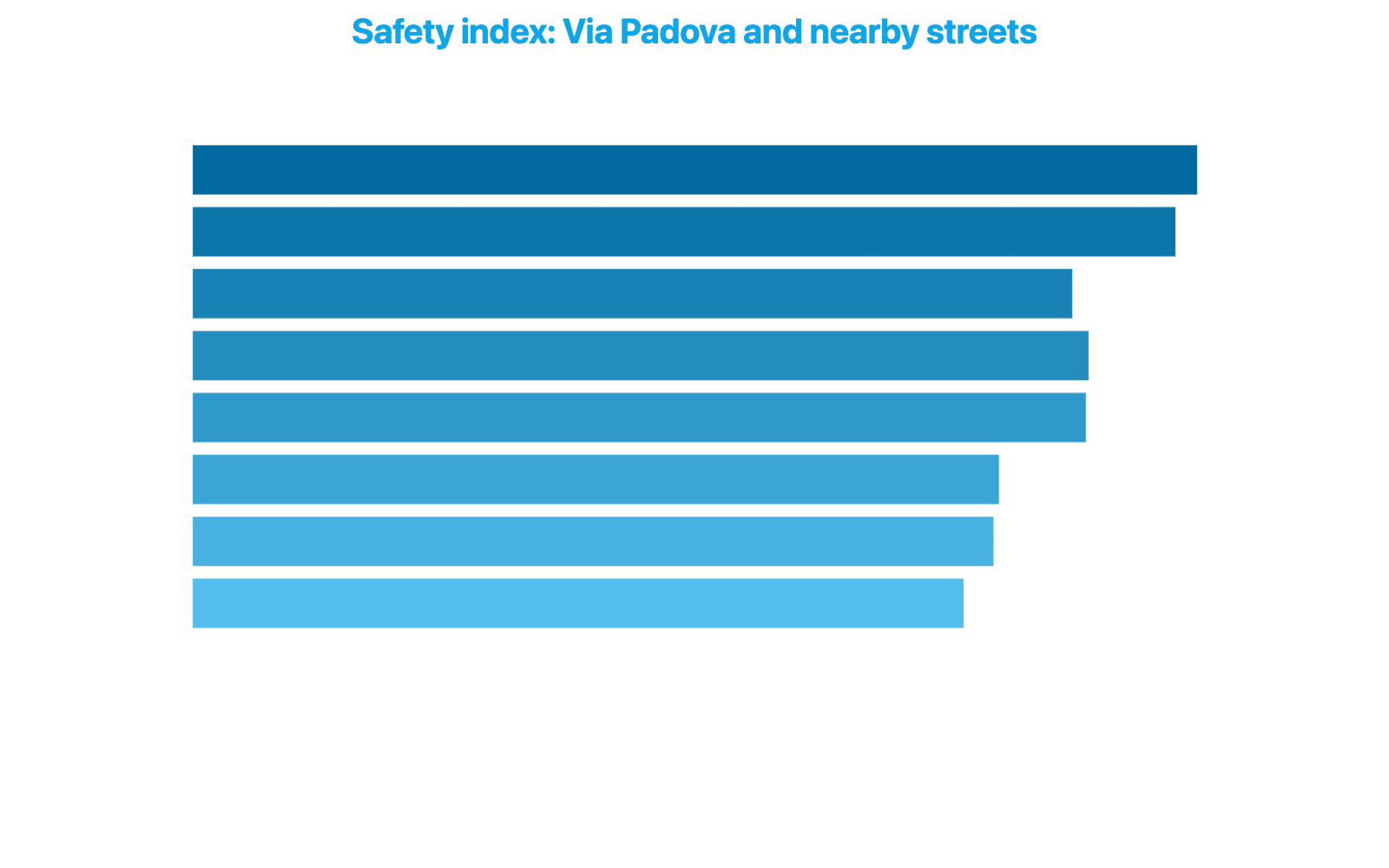
How safe is Via Padova in Milan?
Via Padova records a safety index of zero across 4,006 monitored streets, the lowest score in the entire Milan dataset. The score is calculated across 27 crime categories tracked through news analysis. The citywide median stands at 65.05 points, while neighboring streets average 32.39.
The value paradox
At a baseline of 3,365 euro per sqm -- a value estimated by a proprietary multi-source model that cross-references institutional quotations, recent transactions and listing prices, and which for any individual property can vary by 30% depending on floor, condition and appurtenances -- Via Padova sits in the bottom 23% of Milan, well below the citywide median of 4,268 euro. Yet it is the highest-priced street in the entire Crescenzago neighborhood, where all 31 monitored streets trade at lower values.
Net Long-Term ROI stands at 3.64%, above the citywide average of 3.31%. With rents at 774 euro for a studio and 988 for a one-bedroom apartment -- both below the Milan average, according to real estate listing portals -- and 79 active short-term rental properties tracked by short-term rental data, the mechanism is the classic one for low-price, high-demand areas: sustained percentage yields, in a context where the socioeconomic profile remains fragile. Average neighborhood income is 30,933 euro against a citywide average of 44,488 according to IRPEF tax declarations, and the share of university graduates stops at 15% versus 25.82% according to municipal registry data.
How much does an apartment on Via Padova cost?
The average Price per sqm on Via Padova is 3,365 euro, in the bottom 23% of Milan but the highest among the 31 monitored streets in Crescenzago. The citywide median stands at 4,268 euro per sqm. Net Long-Term ROI reaches 3.64%, above the Milan average of 3.31%, with Studio Rent at 774 euro and 1-Bedroom Rent at 988 euro.
Institutional interventions, unchanged profile
In the immediate vicinity, the Via Padova redevelopment -- a 10 million euro project led by the Municipality of Milan, completed in August 2025 -- and the new Metrotranvia 7 overpass, finished in May of the same year, represent a significant infrastructure investment, as documented by sources specializing in urban development. The platform contains a detailed file for every urban development project within range of the street: category, scale, stakeholders, progress status and timeline. The Cascina Gobba stop on the same tramway line is also under construction nearby, with completion expected by end of 2026.
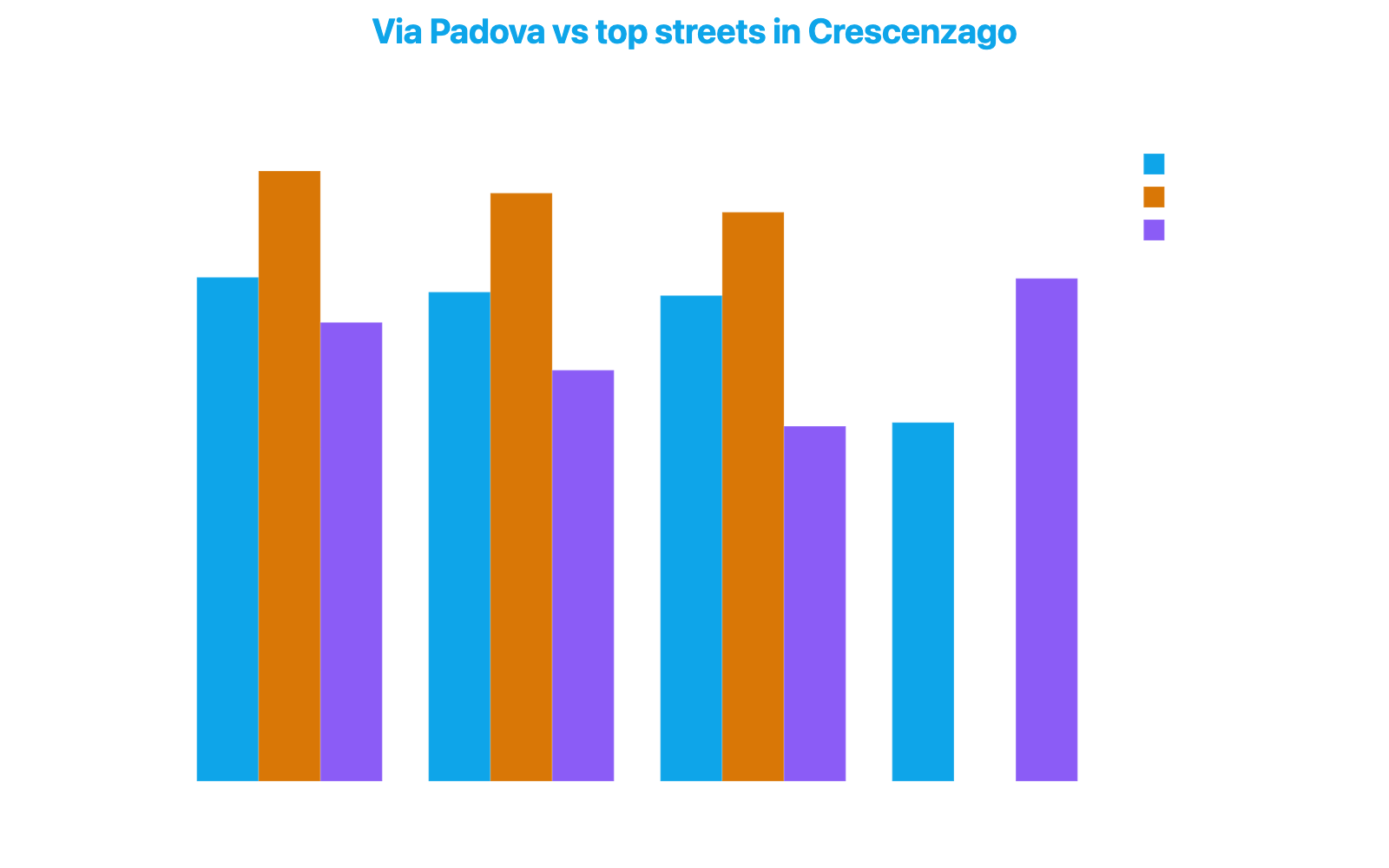
The CityAdvisor Index summarizes the overall profile: 32.27 points, position 3,989 out of 4,006 streets. Via Padova ranks second-to-last in its neighborhood and near the bottom citywide. Retail Offering, its only strength, is not enough to offset a profile where Safety, Urban Decorum, Urban Livability and Demographics all converge toward the bottom of the rankings. The gap between commercial vitality and urban quality remains, in the data, the defining feature of this street.
Methodology: monograph based on 20 metrics calculated across 4,006 streets in Milan. Period: March 2026. Rankings indicate position in the citywide distribution (1 = highest value). Data from public and proprietary sources, covering 4,006 streets, 105 metrics and monthly historical data from January 2020.
Frequently Asked Questions
Is Via Padova dangerous?
According to the analysis conducted across 4,006 streets in Milan, Via Padova records the lowest safety index in the entire dataset: zero points across 27 monitored crime categories. The citywide median is 65.05 points. Even compared to neighboring streets, which average 32.39 points, the gap is stark.
Is Via Padova a good investment?
With an average price of 3,365 euro per sqm and a net Long-Term ROI of 3.64% -- above the Milan average of 3.31% -- Via Padova delivers sustained percentage yields typical of low-cost, high-demand areas. However, the neighborhood's socioeconomic profile remains fragile, with an average income of 30,933 euro versus the citywide average of 44,488.
What redevelopment projects are planned for Via Padova?
The main redevelopment, a 10 million euro project led by the Municipality of Milan, was completed in August 2025. This is complemented by the new Metrotranvia 7 overpass, finished in May 2025, and the Cascina Gobba stop on the same line, expected to be completed by end of 2026.
What are the rental prices on Via Padova?
Rental prices on Via Padova stand at 774 euro per month for a studio and 988 euro for a one-bedroom apartment, both below the Milan average. The area also counts 79 active short-term rental properties, confirming a significant short-term rental market.
How does Via Padova rank compared to the rest of Milan?
The CityAdvisor Index assigns Via Padova 32.27 points, placing it at position 3,989 out of 4,006 streets. The only indicator above average is Shop Density and Commercial Diversity. Safety, Urban Decorum, Aesthetics and the socioeconomic profile all converge toward the bottom of the citywide rankings.